0708-1300/Class notes for Tuesday, April 1: Difference between revisions
No edit summary |
(No difference)
|
Revision as of 12:16, 1 April 2008
| ||||||||||||||||||||||||||||||||||||||||||||||||||||||||||||||||||||||||||||||||||||||||||||||||||||||||||||

Typed Notes
The notes below are by the students and for the students. Hopefully they are useful, but they come with no guarantee of any kind.
First Hour
Theorem
If Failed to parse (SVG (MathML can be enabled via browser plugin): Invalid response ("Math extension cannot connect to Restbase.") from server "https://wikimedia.org/api/rest_v1/":): {\displaystyle \phi:I^k\rightarrow S^n} is an embbeding then Failed to parse (SVG (MathML can be enabled via browser plugin): Invalid response ("Math extension cannot connect to Restbase.") from server "https://wikimedia.org/api/rest_v1/":): {\displaystyle \tilde{H}_*(S^n-\phi(I^k)) = 0}
Proof:
By induction on k.
For k=0 this is easy, is a single point and - a point is just


Now suppose we know the theorem is true for k-1, let be an embedding. Write the cube as where and






So,

where both sets in the union are open. Recall for sets where A and B are open we have the Mayer Vietoris Sequence.

Note: It is usefull to "open the black box" and think about the Mayer Vietoris Sequence from the veiwpoint of singular homology, ie using maps of simplexes and the like. This was briefly sketched in class.
We get a sequence

The first and last terms in this sequence (at least the small part of it we have written) vanish by induction hypothesis.
Note: Technically we need to check at Mayer Vietoris sequence also works for reduced homology.
We thus get the isomorphism:

Assume
As the above isormorphism is induced by the inclusion maps at the chain level, we get that either in or in
![{\displaystyle 0\neq [\beta ]\in {\tilde {H}}_{p}(S^{n}-\phi (C))}](https://wikimedia.org/api/rest_v1/media/math/render/svg/9b683a23c146555d35bbfdef3bc6ea4031c94445)
![{\displaystyle [\beta ]\neq 0}](https://wikimedia.org/api/rest_v1/media/math/render/svg/facc95683a2d6e61bb77611f8bb19632cf5f6746)
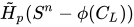
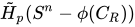
Now repeat, find a sequence of intervals such that

1)

2) in Failed to parse (SVG (MathML can be enabled via browser plugin): Invalid response ("Math extension cannot connect to Restbase.") from server "https://wikimedia.org/api/rest_v1/":): {\displaystyle \tilde{H}_{p}(S^n-\phi(I_j\times I^{k-1}))}
Pictorially, we cut C in half, find which half Failed to parse (SVG (MathML can be enabled via browser plugin): Invalid response ("Math extension cannot connect to Restbase.") from server "https://wikimedia.org/api/rest_v1/":): {\displaystyle [\beta]} is non zero, then cut this half in half and find the one the Failed to parse (SVG (MathML can be enabled via browser plugin): Invalid response ("Math extension cannot connect to Restbase.") from server "https://wikimedia.org/api/rest_v1/":): {\displaystyle [\beta]} is non zero in and again cut it in half, etc...
But, Failed to parse (SVG (MathML can be enabled via browser plugin): Invalid response ("Math extension cannot connect to Restbase.") from server "https://wikimedia.org/api/rest_v1/":): {\displaystyle [\beta] = 0} in Failed to parse (SVG (MathML can be enabled via browser plugin): Invalid response ("Math extension cannot connect to Restbase.") from server "https://wikimedia.org/api/rest_v1/":): {\displaystyle \tilde{H}_{p}(S^n-\phi(\{x\}\times I^{k-1}))} by induction. Hence, Failed to parse (SVG (MathML can be enabled via browser plugin): Invalid response ("Math extension cannot connect to Restbase.") from server "https://wikimedia.org/api/rest_v1/":): {\displaystyle \exists\gamma\in C_{p+1}(S^n-\phi(\{x\}\times I^{k-1}))} such that Failed to parse (SVG (MathML can be enabled via browser plugin): Invalid response ("Math extension cannot connect to Restbase.") from server "https://wikimedia.org/api/rest_v1/":): {\displaystyle \partial\gamma=\beta} .
But, Failed to parse (SVG (MathML can be enabled via browser plugin): Invalid response ("Math extension cannot connect to Restbase.") from server "https://wikimedia.org/api/rest_v1/":): {\displaystyle supp\gamma} = { union of images of simplexes in U} is compact, so, for some j. But this contradicts assumption 2)

Q.E.D
We now prove an analogous theorem for spheres opposed to cubes
Theorem
For Failed to parse (SVG (MathML can be enabled via browser plugin): Invalid response ("Math extension cannot connect to Restbase.") from server "https://wikimedia.org/api/rest_v1/":): {\displaystyle \phi:S^k\rightarrow S^n} an embedding then Failed to parse (SVG (MathML can be enabled via browser plugin): Invalid response ("Math extension cannot connect to Restbase.") from server "https://wikimedia.org/api/rest_v1/":): {\displaystyle \tilde{H}_{p}(S^n-\phi(S^k)) = \mathbb{Z}} if p = n-k-1 and zero otherwise.
Intuitively,Failed to parse (SVG (MathML can be enabled via browser plugin): Invalid response ("Math extension cannot connect to Restbase.") from server "https://wikimedia.org/api/rest_v1/":): {\displaystyle S^n-S^k = S^{n-k-1}}
Recall we had seen this explicitly for Failed to parse (SVG (MathML can be enabled via browser plugin): Invalid response ("Math extension cannot connect to Restbase.") from server "https://wikimedia.org/api/rest_v1/":): {\displaystyle S^3-S^1} when we wrote Failed to parse (SVG (MathML can be enabled via browser plugin): Invalid response ("Math extension cannot connect to Restbase.") from server "https://wikimedia.org/api/rest_v1/":): {\displaystyle S^3} as the union of two tori (an inflated circle)
Proof:
As in the previous proof, we use Mayer Vietoris. Let Failed to parse (SVG (MathML can be enabled via browser plugin): Invalid response ("Math extension cannot connect to Restbase.") from server "https://wikimedia.org/api/rest_v1/":): {\displaystyle S^k = D^k_-\cup D^k_+}
Then, Failed to parse (SVG (MathML can be enabled via browser plugin): Invalid response ("Math extension cannot connect to Restbase.") from server "https://wikimedia.org/api/rest_v1/":): {\displaystyle S^{k-1} = D^k_-\cap D^k_+} Failed to parse (SVG (MathML can be enabled via browser plugin): Invalid response ("Math extension cannot connect to Restbase.") from server "https://wikimedia.org/api/rest_v1/":): {\displaystyle \tilde{H}_{p}(S^n-\phi(S^k))\rightarrow \tilde{H}_{p}(S^n-\phi(D^k_-))\oplus\tilde{H}_{p}(S^n-\phi(D^k_+))\rightarrow \tilde{H}_{p}(S^n-\phi(S^{k-1}))\rightarrow \tilde{H}_{p-1}(S^n-\phi(S^k))}
The first and last term written vanish by induction hypothesis and so have an isomorphism

Hence, it is enough to prove the theorem for k=0. Well in this case we have Failed to parse (SVG (MathML can be enabled via browser plugin): Invalid response ("Math extension cannot connect to Restbase.") from server "https://wikimedia.org/api/rest_v1/":): {\displaystyle \tilde{H}_{p}(S^n-\{2\ pts\})}
Since Failed to parse (SVG (MathML can be enabled via browser plugin): Invalid response ("Math extension cannot connect to Restbase.") from server "https://wikimedia.org/api/rest_v1/":): {\displaystyle S^n-\{2\ pts\}\sim S^{n-1}} , this is Failed to parse (SVG (MathML can be enabled via browser plugin): Invalid response ("Math extension cannot connect to Restbase.") from server "https://wikimedia.org/api/rest_v1/":): {\displaystyle \mathbb{Z}} for p = n-1 and 0 otherwise
Q.E.D
Take k=n-1 Failed to parse (SVG (MathML can be enabled via browser plugin): Invalid response ("Math extension cannot connect to Restbase.") from server "https://wikimedia.org/api/rest_v1/":): {\displaystyle \tilde{H}_{0}(S^n-\phi(S^{n-1})) =\mathbb{Z}} so Failed to parse (SVG (MathML can be enabled via browser plugin): Invalid response ("Math extension cannot connect to Restbase.") from server "https://wikimedia.org/api/rest_v1/":): {\displaystyle H_{0}(S^n-\phi(S^{n-1}))=\mathbb{Z}^2}
Hence the compliment of an n-1 sphere in Failed to parse (SVG (MathML can be enabled via browser plugin): Invalid response ("Math extension cannot connect to Restbase.") from server "https://wikimedia.org/api/rest_v1/":): {\displaystyle S^n} has two connected components. This is the Jordan Curve Theorem.
