0708-1300/Class notes for Thursday, October 4: Difference between revisions
(→Proof) |
mNo edit summary |
||
| Line 5: | Line 5: | ||
==Class Notes== |
==Class Notes== |
||
<span style="color: red;">The notes below are by the students and for the students. Hopefully they are useful, but they come with no guarantee of any kind.</span> |
|||
===Definition=== |
===Definition=== |
||
Let <math>\theta : M^m \rightarrow N^n\!</math> be a smooth map between manifolds. If for each <math>p \in M\!</math> the differential <math>d\theta_p : T_p M \rightarrow T_{\theta(p)} N\!</math> is surjective, <math>\theta\!</math> is called a <b>submersion</b>. |
Let <math>\theta : M^m \rightarrow N^n\!</math> be a smooth map between manifolds. If for each <math>p \in M\!</math> the differential <math>d\theta_p : T_p M \rightarrow T_{\theta(p)} N\!</math> is surjective, <math>\theta\!</math> is called a <b>submersion</b>. |
||
Revision as of 00:35, 5 October 2007
| ||||||||||||||||||||||||||||||||||||||||||||||||||||||||||||||||||||||||||||||||||||||||||||||||||||||||||||

Movie Time
With the word "immersion" in our minds, we watch the movie "Outside In". Also see the movie's home, a talk I once gave, and the movie itself, on google video.
Class Notes
The notes below are by the students and for the students. Hopefully they are useful, but they come with no guarantee of any kind.
Definition
Let [math]\displaystyle{ \theta : M^m \rightarrow N^n\! }[/math] be a smooth map between manifolds. If for each [math]\displaystyle{ p \in M\! }[/math] the differential [math]\displaystyle{ d\theta_p : T_p M \rightarrow T_{\theta(p)} N\! }[/math] is surjective, [math]\displaystyle{ \theta\! }[/math] is called a submersion.
Theorem
If [math]\displaystyle{ \theta : M^m \rightarrow N^n\! }[/math] is a smooth map between manifolds and for some [math]\displaystyle{ p \in M\! }[/math] the differential [math]\displaystyle{ d\theta_p : T_p M \rightarrow T_{\theta(p)} N\! }[/math] is surjective then there exist charts [math]\displaystyle{ \phi : U \rightarrow U' \subset \mathbb{R}^m\! }[/math] and [math]\displaystyle{ \psi : V \rightarrow V' \subset \mathbb{R}^n\! }[/math] on [math]\displaystyle{ M\! }[/math] and [math]\displaystyle{ N\! }[/math] respectively such that
- [math]\displaystyle{ \phi(p) = 0\! }[/math]
- [math]\displaystyle{ \psi\left(\theta(p)\right) = 0\! }[/math]
- The diagram
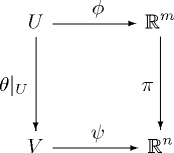
commutes, where [math]\displaystyle{ \pi : \mathbb{R}^m = \mathbb{R}^n \times \mathbb{R}^{m-n} \rightarrow \mathbb{R}^n\! }[/math] is the canonical projection.

Proof
Since translations are diffeomorphisms of [math]\displaystyle{ \mathbb{R}^k\! }[/math] for every [math]\displaystyle{ k \in \mathbb{N}\! }[/math], it is trivial to find charts [math]\displaystyle{ \phi_0 : U_0 \rightarrow U_0' \subset \mathbb{R}^m\! }[/math] and [math]\displaystyle{ \psi : V \rightarrow V' \subset \mathbb{R}^m\! }[/math] such that [math]\displaystyle{ \phi(p) = 0 \in \mathbb{R}^m\! }[/math] and [math]\displaystyle{ \psi(\theta(p)) = 0 \in \mathbb{R}^n\! }[/math]. Furthermore, since [math]\displaystyle{ V\! }[/math] is open, [math]\displaystyle{ U_0\! }[/math] is open and [math]\displaystyle{ \theta\! }[/math] is continuous, [math]\displaystyle{ U_0 \cap \theta^{-1}\left(V\right) \subset M\! }[/math] is open so that we may assume [math]\displaystyle{ U_0 \subset \theta^{-1}\left(V\right)\! }[/math] without loss of generality.
Let [math]\displaystyle{ \theta_0 = \psi \circ \theta \circ \phi_0^{-1} : U_0' \rightarrow V'\! }[/math] be the local representative of [math]\displaystyle{ \theta\! }[/math] and let [math]\displaystyle{ D_0 : \mathbb{R}^m \rightarrow \mathbb{R}^n \! }[/math] be the local representative of [math]\displaystyle{ d\theta_p\! }[/math]. Since [math]\displaystyle{ d\theta_p\! }[/math] is onto, we may apply a change of basis [math]\displaystyle{ T : \mathbb{R}^m \rightarrow \mathbb{R}^m }[/math] such that [math]\displaystyle{ D_0 = T^{-1} \circ \pi \circ T }[/math].
Let [math]\displaystyle{ \phi_1 = T \circ \phi_0\! }[/math]. Then [math]\displaystyle{ \phi_1\! }[/math] is a chart because [math]\displaystyle{ T\! }[/math] is a diffeomorphism. Let [math]\displaystyle{ \theta_1 = \psi \circ \theta \circ \phi_1^{-1} : U_0' \rightarrow V'\! }[/math] be the corresponding local representative, define [math]\displaystyle{ \zeta : U_0' \rightarrow \mathbb{R}^m\! }[/math] by [math]\displaystyle{ \zeta(x,y) = (\theta_1(x,y),y)\! }[/math], and let [math]\displaystyle{ D_1 : \mathbb{R}^m \rightarrow \mathbb{R}^n\! }[/math] be the differential of [math]\displaystyle{ \theta_1\! }[/math] at [math]\displaystyle{ 0\! }[/math]. Then, by construction of [math]\displaystyle{ T\! }[/math] we have that [math]\displaystyle{ D_1 = \pi\! }[/math] and hence [math]\displaystyle{ d \zeta_0 = \mathrm{id}_{\mathbb{R}^m}\! }[/math], which is invertible. Hence, the inverse function gives the existence of non-empty open set [math]\displaystyle{ U' \subset \zeta(U_1')\! }[/math] such that [math]\displaystyle{ \zeta|_{\zeta^{-1}(U')}\! }[/math] is a diffeomorphism. Put [math]\displaystyle{ U = \phi_1^{-1}(\zeta^{-1}(U'))\! }[/math] and [math]\displaystyle{ \phi = \zeta \circ \phi_1|_U\! }[/math]. Then [math]\displaystyle{ \phi\! }[/math] is a chart.
It remains to check that [math]\displaystyle{ \pi \circ \phi = \psi \circ \theta|_U\! }[/math], but this is clear: if [math]\displaystyle{ (x,y) = \phi_1(q)\! }[/math] for some [math]\displaystyle{ q \in U\! }[/math], then [math]\displaystyle{ \pi\circ\phi(q) = \pi\circ\zeta(x,y) = \theta_1(x,y) = \psi(\theta(q))\! }[/math] by definition of [math]\displaystyle{ \theta_1\! }[/math]. [math]\displaystyle{ \Box\! }[/math]
