09-240/Classnotes for Tuesday September 29
| ||||||||||||||||||||||||||||||||||||||||||||||||||||||||||||||||||

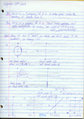
Yangjiay - Page 1
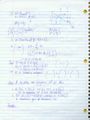
Page 2
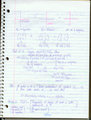
Page 3
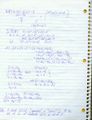
Page 4
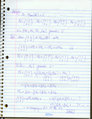
Page 5
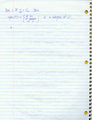
Page 6


Vector subspaces
Definition. [math]\displaystyle{ \mathbf W \subset \mathbf V }[/math] is a "subspace" if it is a vector space under the operations it inherits from V.
Theorem. [math]\displaystyle{ \mathbf W \subset \mathbf V }[/math] is a subspace iff it is "closed under addition and vector multiplication by scalars", i.e. [math]\displaystyle{ x, y \in \mathbf W \Rightarrow x + y \in \mathbf W }[/math] and [math]\displaystyle{ a \in F, x \in \mathbf W \Rightarrow ax \in \mathbf W }[/math].
Goal: Every VS has a "basis", so while we don't have to use coordinates, we always can.
Examples of what is not a subspace (without diagrams):
- A unit circle is not closed under addition of scalar multiplication.
- The x-axis [math]\displaystyle{ \cup }[/math] y-axis is closed under scalar multiplication, but not under addition.
- A single quadrant of the Cartesian plane is closed under addition, but not under scalar multiplication.
Examples of subspaces:
- [math]\displaystyle{ \{0\} }[/math]
- Any VS (which is a subspace of itself)
- A line passing through the origin (if it does not pass through the origin, then it is not closed under scalar multiplication)
- A plane
- Let [math]\displaystyle{ \mathbf V = \mathbb M_{n \times n}(F) }[/math]. If [math]\displaystyle{ W = \{ A \in \mathbf V : A^\top = A \} }[/math], then W is a subspace of V. (W is the set of "symmetric" matrices in V; AT denotes the transpose of A.)
- [math]\displaystyle{ \mathbf W = \{ A \in \mathbb M_{n \times n} : \operatorname{tr}(A) = 0 \} }[/math]
- where [math]\displaystyle{ \operatorname{tr}(A) = \sum_{i=1}^n a_{ii} }[/math] is the "trace" of A.
- Properties of trace:
- [math]\displaystyle{ \operatorname{tr}(0 \cdot A) = 0 }[/math]
- [math]\displaystyle{ \operatorname{tr}(cA) = c \cdot \operatorname{tr}(A) }[/math]
- [math]\displaystyle{ \operatorname{tr}(A + B) = \operatorname{tr}(A) + \operatorname{tr}(B) }[/math]
- so W is indeed a subspace.
Claim: If W1 and W2 are subspaces of V, then
- [math]\displaystyle{ W_1 \cap W_2 = \{ x \in \mathbf V : x \in \mathbf W_1 \mbox{ and } \mathbf W_2 \} }[/math] is a subspace of V, W1, and W2.
- But [math]\displaystyle{ W_1 \cup W_2 = \{ x \in \mathbf V : x \in \mathbf W_1 \mbox{ or } x \in \mathbf W_2 \} }[/math] is a subspace of V iff [math]\displaystyle{ \mathbf W_1 \subset \mathbf W_2 }[/math] or [math]\displaystyle{ \mathbf W_2 \subset \mathbf W_1 }[/math]. (See HW2 pp. 20-21, #19.)
Linear combinations
Definition: A vector u is a "linear combination" (l.c.) of vectors u1, ..., un if there exists scalars a1, ..., an such that
- [math]\displaystyle{ u = a_1 u_1 + a_2 u_2 + \ldots + a_n u_n }[/math]
Example: [math]\displaystyle{ \mathbb P_n(F) = \{ \mbox{Polynomials of degree at most } n \mbox{ with coefficients in } F \} }[/math]
[math]\displaystyle{ = \left\{ \sum_{i=0}^n a_i x^i : a_i \in F \right\} }[/math]
Definition: A subset [math]\displaystyle{ S \subset \mathbf V }[/math] "generates" or "spans" V iff the set of linear combinations of elements of S is all of V.
Example: Let [math]\displaystyle{ \mathbf V = \mathbb M_{n \times n}(\real) }[/math]
Let [math]\displaystyle{ M_1 = \begin{pmatrix} 1 & 0 \\ 0 & 0 \end{pmatrix}, M_2 = \begin{pmatrix} 0 & 1 \\ 0 & 0 \end{pmatrix}, M_3 = \begin{pmatrix} 0 & 0 \\ 1 & 0 \end{pmatrix}, M_4 = \begin{pmatrix} 0 & 0 \\ 0 & 1 \end{pmatrix} }[/math]
Then [math]\displaystyle{ S = \{ M_1, M_2, M_3, M_4 \} }[/math] generates V.
Proof: Given [math]\displaystyle{ \begin{pmatrix} a & b \\ c & d \end{pmatrix} \in \mathbb M_{2 \times 2}(\real) }[/math], write
[math]\displaystyle{ \begin{pmatrix} a & b \\ c & d \end{pmatrix} = aM_1 + bM_2 + cM_3 + dM_4. }[/math]
Example: Let [math]\displaystyle{ N_1 = \begin{pmatrix} 0 & 1 \\ 1 & 1 \end{pmatrix}, N_2 = \begin{pmatrix} 1 & 0 \\ 1 & 1 \end{pmatrix}, N_3 = \begin{pmatrix} 1 & 1 \\ 0 & 1 \end{pmatrix}, N_4 = \begin{pmatrix} 1 & 1 \\ 1 & 0 \end{pmatrix} }[/math]
Does [math]\displaystyle{ \{ N_1, N_2, N_3, N_4 \} }[/math] generate V?
- [math]\displaystyle{ M_1 = -\frac23 N_1 + \frac13(N_2 + N_3 + N_4) }[/math]
- [math]\displaystyle{ M_2 = -\frac23 N_2 + \frac13(N_1 + N_3 + N_4) }[/math]
- [math]\displaystyle{ M_3 = -\frac23 N_3 + \frac13(N_1 + N_2 + N_4) }[/math]
- [math]\displaystyle{ M_4 = -\frac23 N_4 + \frac13(N_1 + N_2 + N_3) }[/math]
Then [math]\displaystyle{ \begin{pmatrix} a & b \\ c & d \end{pmatrix} = aM_1 + bM_2 + cM_3 + dM_4 = }[/math]
- [math]\displaystyle{ a \cdot \left( -\frac23 N_1 + \frac13(N_2 + N_3 + N_4) \right) + b \cdot \left( -\frac23 N_2 + \frac13(N_1 + N_3 + N_4) \right) + \ldots }[/math]
Theorem: If [math]\displaystyle{ S \in \mathbf V }[/math], then [math]\displaystyle{ \operatorname{span}(S) = }[/math] {all l.c. of elements of S} is a subspace of V.
