09-240/Classnotes for Tuesday December 1
| ||||||||||||||||||||||||||||||||||||||||||||||||||||||||||||||||||


A complete set of the December 1st lecture notes given by Professor Dror Bar-Natan for the Fall Session of MAT240 at the University of Toronto.
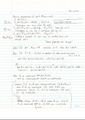
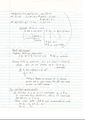
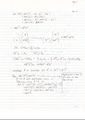
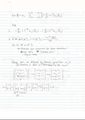
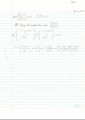
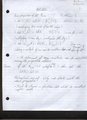
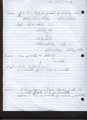
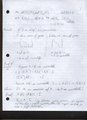
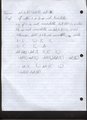
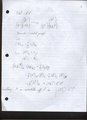
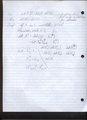
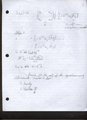


~In the above gallery, there is a complete copy of notes for the lecture given on December 1st by Professor Natan (in PDF format).
--- Wiki Format ---
MAT240 – December 1st
Basic Properties of [math]\displaystyle{ \det : \mathbb M_{n \times n} \rightarrow F }[/math]:
(Note that det(EA) = det(E)·det(A) and that det(A) may be written as |A|.)
0. [math]\displaystyle{ \,\! \det(I) = 1 }[/math]
1. [math]\displaystyle{ \det(E^1_{i,j}A) = -\det(A) ; |E^1_{i,j}|= -1 }[/math]
- Exchanging two rows flips the sign.
2. [math]\displaystyle{ \det(E^2_{i,c}A) = c \cdot \det(A) ; |E^2_{i,c}| = c }[/math]
- These are "enough"!
3. [math]\displaystyle{ \det(E^3_{i,j,c}A) = \det(A) ; |E^3_{i,j,c}| = 1 }[/math]
- Adding a multiple of one row to another does not change the determinant.
The determinant of any matrix can be calculated using the properties above.
Theorem:
If [math]\displaystyle{ {\det}' : \mathbb M_{n \times n} \rightarrow F }[/math] satisfies properties 0-3 above, then [math]\displaystyle{ \det' = \det }[/math]
[math]\displaystyle{ \det(A) = \det'(A) }[/math]
Philosophical remark: Why not begin our inquiry with the properties above?
We must find an implied need for their use; thus, we must know whether a function [math]\displaystyle{ \det }[/math] exists first.
