09-240/Classnotes for Tuesday September 15
| ||||||||||||||||||||||||||||||||||||||||||||||||||||||||||||||||||

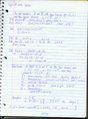
Yangjiay - Page 1
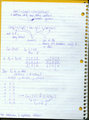
Page 2
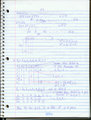
Page 3
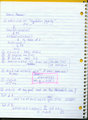
Page 4
Page 5


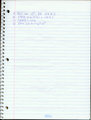
The real numbers A set [math]\displaystyle{ \mathbb R }[/math] with two binary operators and two special elements [math]\displaystyle{ 0, 1 \in \mathbb R }[/math] s.t.
- [math]\displaystyle{ F1.\quad \forall a, b \in \mathbb R, a + b = b + a \mbox{ and } a \cdot b = b \cdot a }[/math]
- [math]\displaystyle{ F2.\quad \forall a, b, c, (a + b) + c = a + (b + c) \mbox{ and } (a \cdot b) \cdot c = a \cdot (b \cdot c) }[/math]
- [math]\displaystyle{ \mbox{(So for any real numbers } a_1, a_2, ..., a_n, \mbox{ one can sum them in any order and achieve the same result.} }[/math]
- [math]\displaystyle{ F3.\quad \forall a, a + 0 = a \mbox{ and } a \cdot 0 = 0 \mbox{ and } a \cdot 1 = a }[/math]
- [math]\displaystyle{ F4.\quad \forall a, \exists b, a + b = 0 \mbox{ and } \forall a \ne 0, \exists b, a \cdot b = 1 }[/math]
- [math]\displaystyle{ \mbox{So } a + (-a) = 0 \mbox{ and } a \cdot a^{-1} = 1 }[/math]
- [math]\displaystyle{ \mbox{(So } (a + b) \cdot (a - b) = a^2 - b^2) }[/math]
- [math]\displaystyle{ \forall a, \exists x, x \cdot x = a \mbox{ or } a + x \cdot x = 0 }[/math]
- Note: or means inclusive or in math.
- [math]\displaystyle{ F5.\quad (a + b) \cdot c = a \cdot c + b \cdot c }[/math]
Definition: A field is a set F with two binary operators [math]\displaystyle{ \,\!+ }[/math]: F×F → F, [math]\displaystyle{ \times\,\! }[/math]: F×F → F and two elements [math]\displaystyle{ 0, 1 \in \mathbb R }[/math] s.t.
- [math]\displaystyle{ F1\quad \mbox{Commutativity } a + b = b + a \mbox{ and } a \cdot b = b \cdot a \forall a, b \in F }[/math]
- [math]\displaystyle{ F2\quad \mbox{Associativity } (a + b) + c = a + (b + c) \mbox{ and } (a \cdot b) \cdot c = a \cdot (b \cdot c) }[/math]
- [math]\displaystyle{ F3\quad a + 0 = a, a \cdot 1 = a }[/math]
- [math]\displaystyle{ F4\quad \forall a, \exists b, a + b = 0 \mbox{ and } \forall a \ne 0, \exists b, a \cdot b = 1 }[/math]
- [math]\displaystyle{ F5\quad \mbox{Distributivity } (a + b) \cdot c = a \cdot c + b \cdot c }[/math]
Examples
- [math]\displaystyle{ F = \mathbb R }[/math]
- [math]\displaystyle{ F = \mathbb Q }[/math]
- [math]\displaystyle{ \mathbb C = \{ a + bi : a, b \in \mathbb R \} }[/math]
- [math]\displaystyle{ i = \sqrt{-1} }[/math]
- [math]\displaystyle{ \,\!(a + bi) + (c + di) = (a + c) + (b + d)i }[/math]
- [math]\displaystyle{ \,\!0 = 0 + 0i, 1 = 1 + 0i }[/math]
- [math]\displaystyle{ \,\!F_2 = \{ 0, 1 \} }[/math]
- [math]\displaystyle{ \,\!F_7 = \{ 0, 1,2,3,4,5,6 \} }[/math]
- [math]\displaystyle{ \,\!F_6 = \{ 0, 1,2,3,4,5 \} }[/math] is not a field because not every element has a multiplicative inverse.
- Let [math]\displaystyle{ a = 2. }[/math]
- Then [math]\displaystyle{ a \cdot 0 = 0, a \cdot 1 = 2, a \cdot 3 = 0, a \cdot 4 = 2, a \cdot 5 = 4 }[/math]
- Therefore F4 fails; there is no number b in F6 s.t. a · b = 1
|
| ||||||||||||||||||||||||||||||||||||||||||||||||||||||||||||||||||||||||||||||||||||||||||||||||||||||||||||||||||||||||||||||||
|
|
Multiplication is repeated addition.
[math]\displaystyle{ 23 \times 27 = \begin{matrix} 27 \\ \overbrace{23 + 23 + 23 + \cdots + 23} \end{matrix} = 621 }[/math]
[math]\displaystyle{ 27 \times 23 = \begin{matrix} 23 \\ \overbrace{27 + 27 + 27 + \cdots + 27} \end{matrix} = 621 }[/math]
One may interpret this as counting the units in a 23×27 rectangle; one may choose to count along either 23 rows or 27 columns, but both ways lead to the same answer.
Exponentiation is repeated multiplication, but it does not have the same properties as multiplication; 23 = 8, but 32 = 9.
Theorem: [math]\displaystyle{ \,\! F_p }[/math] for [math]\displaystyle{ p \gt 1 }[/math] is a field iff (if and only if) [math]\displaystyle{ p }[/math] is a prime number
Tedious Theorem
- [math]\displaystyle{ a + b = c + d \Rightarrow a = c }[/math] "cancellation property"
- Proof:
- By F4, [math]\displaystyle{ \exists d \mbox{ s.t. } b + d = 0 }[/math]
- [math]\displaystyle{ \,\! (a + b) + d = (c + b) + d }[/math]
- [math]\displaystyle{ \Rightarrow a + (b + d) = c + (b + d) }[/math] by F2
- [math]\displaystyle{ \Rightarrow a + 0 = c + 0 }[/math] by choice of d
- [math]\displaystyle{ \Rightarrow a = c }[/math] by F3
- [math]\displaystyle{ a \cdot b = c \cdot b , (b \ne 0) \Rightarrow a = c }[/math]
- [math]\displaystyle{ a + O' = a \Rightarrow O' = 0 }[/math]
- Proof:
- [math]\displaystyle{ \,\! a + O' = a }[/math]
- [math]\displaystyle{ \Rightarrow a + O' = a + 0 }[/math] by F3
- [math]\displaystyle{ \Rightarrow O' = 0 }[/math] by adding the additive inverse of a to both sides
- [math]\displaystyle{ a \cdot l' = a, a \ne 0 \Rightarrow l' = 1 }[/math]
- [math]\displaystyle{ a + b = 0 = a + b' \Rightarrow b = b' }[/math]
- [math]\displaystyle{ a \cdot b = 1 = a \cdot b' \Rightarrow b = b' = a^{-1} }[/math]
- [math]\displaystyle{ \,\! \mbox{Aside: } a - b = a + (-b) }[/math]
- [math]\displaystyle{ \frac ab = a \cdot b^{-1} }[/math]
- [math]\displaystyle{ \,\! -(-a) = a, (a^{-1})^{-1} }[/math]
- [math]\displaystyle{ a \cdot 0 = 0 }[/math]
- Proof:
- [math]\displaystyle{ a \cdot 0 = a(0 + 0) }[/math] by F3
- [math]\displaystyle{ = a \cdot 0 + a \cdot 0 }[/math] by F5
- [math]\displaystyle{ = 0 = a \cdot 0 }[/math]
- [math]\displaystyle{ \forall b, 0 \cdot b \ne 1 }[/math]
- So there is no 0−1
- [math]\displaystyle{ (-a) \cdot b = a \cdot (-b) = -(a \cdot b) }[/math]
- [math]\displaystyle{ (-a) \cdot (-b) = a \cdot b }[/math]
- (Bonus) [math]\displaystyle{ \,\! (a + b)(a - b) = a^2 - b^2 }[/math]
Quotation of the Day
......
