09-240/Classnotes for Tuesday September 22: Difference between revisions
No edit summary |
m (→Class notes for today: Format.) |
||
| (7 intermediate revisions by 3 users not shown) | |||
| Line 2: | Line 2: | ||
==Some links== |
==Some links== |
||
* {{Pensieve Link|2009-09/nb/09-240-TheComplexField.pdf|The Complex Numbers by Computer}}. |
|||
* Dori Eldar's work on "mechanical computations": {{Home Link|People/Eldar/thesis/linkfunc.htm|Machines as Calculating Devices}} and {{Home Link|People/Eldar/thesis/squaring.htm|Computing the function <math>W=Z^2</math> the hard way}}. |
* Dori Eldar's work on "mechanical computations": {{Home Link|People/Eldar/thesis/linkfunc.htm|Machines as Calculating Devices}} and {{Home Link|People/Eldar/thesis/squaring.htm|Computing the function <math>W=Z^2</math> the hard way}}. |
||
* The "Dimensions" video on "Nombres complexes", is at http://dimensions-math.org/Dim_reg_AM.htm (and then go to "Dimensions_5". |
* The "Dimensions" video on "Nombres complexes", is at http://dimensions-math.org/Dim_reg_AM.htm (and then go to "Dimensions_5". |
||
| Line 8: | Line 9: | ||
{{09-240/Class Notes Warning}} |
{{09-240/Class Notes Warning}} |
||
==Class notes for today== |
==Class notes for today== |
||
<gallery> |
|||
Image:September 22 2009 lecture notes page 1.jpg|[[User:Yangjiay|Yangjiay]] - Page 1 |
|||
Image:September 22 2009 lecture notes page 2.jpg|Page 2 |
|||
Image:September 22 2009 lecture notes page 3.jpg|Page 3 |
|||
Image:September 22 2009 lecture notes page 4.jpg|Page 4 |
|||
Image:September 22 2009 lecture notes page 5.jpg|Page 5 |
|||
</gallery> |
|||
Vectors: |
|||
# can be added |
|||
# can be multiplied by a number (not another vector) |
|||
Let ''F'' be a field. A vector space ''V'' over the field ''F'' is a set ''V'' (of vectors) with a special element 0<sub>''V''</sub>, a binary operation + : ''V'' × ''V'' → ''V'', a binary operation • : ''F'' × ''V'' → ''V''. |
|||
{| style="border: solid 1px black" |
|||
|- |
|||
| Convention for today: |
|||
: <math>x, y, z \in \mathbf V</math> |
|||
: <math>a, b, c \in F</math> |
|||
|} |
|||
VS1 <math>\forall x, y \in \mathbf V, x + y = y + x</math><br /> |
|||
VS2 <math>\cdots (x + y) + z = x + (y + z)</math><br /> |
|||
VS3 <math>\cdots x + 0 = x</math><br /> |
|||
VS4 <math>\forall x, \exists y \mbox{ s.t. } x + y = 0</math><br /> |
|||
VS5 <math>1 \cdot x = x</math><br /> |
|||
VS6 <math>a \cdot (b \cdot x) = (a \cdot b) \cdot x</math><br /> |
|||
VS7 <math>a \cdot (x + y) = ax + ay</math><br /> |
|||
VS8 <math>(a + b) \cdot x = ax + bx</math> |
|||
=== Proof of VS4 === |
|||
Take an arbitrary <math>x = \begin{pmatrix} a_1 \\ a_2 \\ \vdots \\ a_n \end{pmatrix} \in F^n</math> |
|||
Set <math>y = \begin{pmatrix} -a_1 \\ -a_2 \\ \vdots \\ -a_n \end{pmatrix}</math> and note |
|||
: <math>x + y = \begin{pmatrix} a_1 \\ a_2 \\ \vdots \\ a_n \end{pmatrix} + \begin{pmatrix} -a_1 \\ -a_2 \\ \vdots \\ -a_n \end{pmatrix} = \begin{pmatrix} a_1 + (-a_1) \\ a_2 + (-a_2) \\ \vdots \\ a_n + (-a_n) \end{pmatrix} = \begin{pmatrix} 0 \\ 0 \\ \vdots \\ 0 \end{pmatrix} = 0_{F^n}</math> |
|||
=== Examples === |
|||
# <math>F^n \mbox{ for } n \in \mathbb N</math> |
|||
#: <math>F^n = \left\{ \begin{pmatrix} a_1 \\ a_2 \\ \vdots \\ a_n \end{pmatrix} : a_i \in F \right\}</math> |
|||
#: <math>\begin{pmatrix} a_1 \\ a_2 \\ \vdots \\ a_n \end{pmatrix} + \begin{pmatrix} b_1 \\ b_2 \\ \vdots \\ b_n \end{pmatrix} = \begin{pmatrix} a_1 + b_1 \\ a_2 + b_2 \\ \vdots \\ a_n + b_n \end{pmatrix}</math> |
|||
#: <math>a \begin{pmatrix} b_1 \\ b_2 \\ \vdots \\ b_n \end{pmatrix} = \begin{pmatrix} ab_1 \\ ab_2 \\ \vdots \\ ab_n \end{pmatrix}</math> |
|||
#: ... |
|||
# <math>\mathrm M_{m \times n}(F)</math> |
|||
#: ... |
|||
# <math>\mathcal F(S, F)</math> |
|||
# Polynomials |
|||
# <math>...</math> |
|||
=== Food for thought === |
|||
What is wrong with setting |
|||
<math> |
|||
\begin{pmatrix} |
|||
2 & 3 \\ |
|||
4 & 5 \\ |
|||
\end{pmatrix} \cdot \begin{pmatrix} |
|||
6 & 7 \\ |
|||
8 & 9 \\ |
|||
\end{pmatrix} = \begin{pmatrix} |
|||
2 \cdot 6 & 3 \cdot 7 \\ |
|||
4 \cdot 8 & 5 \cdot 9 \\ |
|||
\end{pmatrix} = \begin{pmatrix} |
|||
12 & 21 \\ |
|||
32 & 45 \\ |
|||
\end{pmatrix} ? |
|||
</math> |
|||
# Unnecessary for a V.S. |
|||
# This is useless, since it does not describe reality. For example, a mathematical theory with 46 dimensions can be perfect and mathematically elegant, but if the only solution to it is a universe in which life cannot form it is not reality, hence we have no use for it. |
|||
Latest revision as of 17:49, 24 September 2009
| ||||||||||||||||||||||||||||||||||||||||||||||||||||||||||||||||||

Some links
- The Complex Numbers by Computer.
- Dori Eldar's work on "mechanical computations": Machines as Calculating Devices and Computing the function [math]\displaystyle{ W=Z^2 }[/math] the hard way.
- The "Dimensions" video on "Nombres complexes", is at http://dimensions-math.org/Dim_reg_AM.htm (and then go to "Dimensions_5".
Class notes for today
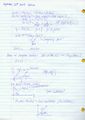
Yangjiay - Page 1
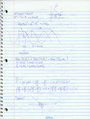
Page 2
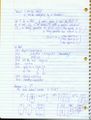
Page 3
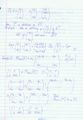
Page 4
Page 5


Vectors:
- can be added
- can be multiplied by a number (not another vector)
Let F be a field. A vector space V over the field F is a set V (of vectors) with a special element 0V, a binary operation + : V × V → V, a binary operation • : F × V → V.
Convention for today:
|
VS1 [math]\displaystyle{ \forall x, y \in \mathbf V, x + y = y + x }[/math]
VS2 [math]\displaystyle{ \cdots (x + y) + z = x + (y + z) }[/math]
VS3 [math]\displaystyle{ \cdots x + 0 = x }[/math]
VS4 [math]\displaystyle{ \forall x, \exists y \mbox{ s.t. } x + y = 0 }[/math]
VS5 [math]\displaystyle{ 1 \cdot x = x }[/math]
VS6 [math]\displaystyle{ a \cdot (b \cdot x) = (a \cdot b) \cdot x }[/math]
VS7 [math]\displaystyle{ a \cdot (x + y) = ax + ay }[/math]
VS8 [math]\displaystyle{ (a + b) \cdot x = ax + bx }[/math]
Proof of VS4
Take an arbitrary [math]\displaystyle{ x = \begin{pmatrix} a_1 \\ a_2 \\ \vdots \\ a_n \end{pmatrix} \in F^n }[/math]
Set [math]\displaystyle{ y = \begin{pmatrix} -a_1 \\ -a_2 \\ \vdots \\ -a_n \end{pmatrix} }[/math] and note
- [math]\displaystyle{ x + y = \begin{pmatrix} a_1 \\ a_2 \\ \vdots \\ a_n \end{pmatrix} + \begin{pmatrix} -a_1 \\ -a_2 \\ \vdots \\ -a_n \end{pmatrix} = \begin{pmatrix} a_1 + (-a_1) \\ a_2 + (-a_2) \\ \vdots \\ a_n + (-a_n) \end{pmatrix} = \begin{pmatrix} 0 \\ 0 \\ \vdots \\ 0 \end{pmatrix} = 0_{F^n} }[/math]
Examples
- [math]\displaystyle{ F^n \mbox{ for } n \in \mathbb N }[/math]
- [math]\displaystyle{ F^n = \left\{ \begin{pmatrix} a_1 \\ a_2 \\ \vdots \\ a_n \end{pmatrix} : a_i \in F \right\} }[/math]
- [math]\displaystyle{ \begin{pmatrix} a_1 \\ a_2 \\ \vdots \\ a_n \end{pmatrix} + \begin{pmatrix} b_1 \\ b_2 \\ \vdots \\ b_n \end{pmatrix} = \begin{pmatrix} a_1 + b_1 \\ a_2 + b_2 \\ \vdots \\ a_n + b_n \end{pmatrix} }[/math]
- [math]\displaystyle{ a \begin{pmatrix} b_1 \\ b_2 \\ \vdots \\ b_n \end{pmatrix} = \begin{pmatrix} ab_1 \\ ab_2 \\ \vdots \\ ab_n \end{pmatrix} }[/math]
- ...
- [math]\displaystyle{ \mathrm M_{m \times n}(F) }[/math]
- ...
- [math]\displaystyle{ \mathcal F(S, F) }[/math]
- Polynomials
- [math]\displaystyle{ ... }[/math]
Food for thought
What is wrong with setting
[math]\displaystyle{ \begin{pmatrix} 2 & 3 \\ 4 & 5 \\ \end{pmatrix} \cdot \begin{pmatrix} 6 & 7 \\ 8 & 9 \\ \end{pmatrix} = \begin{pmatrix} 2 \cdot 6 & 3 \cdot 7 \\ 4 \cdot 8 & 5 \cdot 9 \\ \end{pmatrix} = \begin{pmatrix} 12 & 21 \\ 32 & 45 \\ \end{pmatrix} ? }[/math]
- Unnecessary for a V.S.
- This is useless, since it does not describe reality. For example, a mathematical theory with 46 dimensions can be perfect and mathematically elegant, but if the only solution to it is a universe in which life cannot form it is not reality, hence we have no use for it.
