09-240/Classnotes for Tuesday September 15: Difference between revisions
No edit summary |
|||
| Line 181: | Line 181: | ||
One may interpret this as counting the units in a 23×27 rectangle; one may choose to count along either 23 rows or 27 columns, but both ways lead to the same answer. |
One may interpret this as counting the units in a 23×27 rectangle; one may choose to count along either 23 rows or 27 columns, but both ways lead to the same answer. |
||
You may also think of it as 27-n=23 23*23 + 23*n = 27*23. |
|||
Exponentiation is repeated multiplication, but it does not have the same properties as multiplication; 2<sup>3</sup> = 8, but 3<sup>2</sup> = 9. |
Exponentiation is repeated multiplication, but it does not have the same properties as multiplication; 2<sup>3</sup> = 8, but 3<sup>2</sup> = 9. |
||
Revision as of 17:46, 17 September 2009
| ||||||||||||||||||||||||||||||||||||||||||||||||||||||||||||||||||

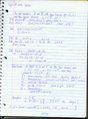
Yangjiay - Page 1
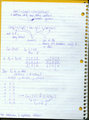
Page 2
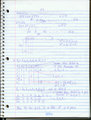
Page 3
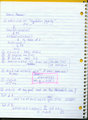
Page 4
Page 5


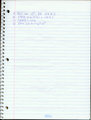
The real numbers A set [math]\displaystyle{ \mathbb R }[/math] with two binary operators and two special elements [math]\displaystyle{ 0, 1 \in \mathbb R }[/math] s.t.
- [math]\displaystyle{ F1.\quad \forall a, b \in \mathbb R, a + b = b + a \mbox{ and } a \cdot b = b \cdot a }[/math]
- [math]\displaystyle{ F2.\quad \forall a, b, c, (a + b) + c = a + (b + c) \mbox{ and } (a \cdot b) \cdot c = a \cdot (b \cdot c) }[/math]
- [math]\displaystyle{ \mbox{(So for any real numbers } a_1, a_2, ..., a_n, \mbox{ one can sum them in any order and achieve the same result.} }[/math]
- [math]\displaystyle{ F3.\quad \forall a, a + 0 = a \mbox{ and } a \cdot 1 = a }[/math]
- [math]\displaystyle{ F4.\quad \forall a, \exists b, a + b = 0 \mbox{ and } \forall a \ne 0, \exists b, a \cdot b = 1 }[/math]
- [math]\displaystyle{ \mbox{So } a + (-a) = 0 \mbox{ and } a \cdot a^{-1} = 1 }[/math]
- [math]\displaystyle{ \mbox{(So } (a + b) \cdot (a - b) = a^2 - b^2) }[/math]
- [math]\displaystyle{ \forall a, \exists x, x \cdot x = a \mbox{ or } a + x \cdot x = 0 }[/math]
- Note: or means inclusive or in math.
- [math]\displaystyle{ F5.\quad (a + b) \cdot c = a \cdot c + b \cdot c }[/math]
Definition: A field is a set F with two binary operators [math]\displaystyle{ \,\!+ }[/math]: F×F → F, [math]\displaystyle{ \times\,\! }[/math]: F×F → F and two elements [math]\displaystyle{ 0, 1 \in \mathbb R }[/math] s.t.
- [math]\displaystyle{ F1\quad \mbox{Commutativity } a + b = b + a \mbox{ and } a \cdot b = b \cdot a \forall a, b \in F }[/math]
- [math]\displaystyle{ F2\quad \mbox{Associativity } (a + b) + c = a + (b + c) \mbox{ and } (a \cdot b) \cdot c = a \cdot (b \cdot c) }[/math]
- [math]\displaystyle{ F3\quad a + 0 = a, a \cdot 1 = a }[/math]
- [math]\displaystyle{ F4\quad \forall a, \exists b, a + b = 0 \mbox{ and } \forall a \ne 0, \exists b, a \cdot b = 1 }[/math]
- [math]\displaystyle{ F5\quad \mbox{Distributivity } (a + b) \cdot c = a \cdot c + b \cdot c }[/math]
Examples
- [math]\displaystyle{ F = \mathbb R }[/math]
- [math]\displaystyle{ F = \mathbb Q }[/math]
- [math]\displaystyle{ \mathbb C = \{ a + bi : a, b \in \mathbb R \} }[/math]
- [math]\displaystyle{ i = \sqrt{-1} }[/math]
- [math]\displaystyle{ \,\!(a + bi) + (c + di) = (a + c) + (b + d)i }[/math]
- [math]\displaystyle{ \,\!0 = 0 + 0i, 1 = 1 + 0i }[/math]
- [math]\displaystyle{ \,\!F_2 = \{ 0, 1 \} }[/math]
- [math]\displaystyle{ \,\!F_7 = \{ 0, 1,2,3,4,5,6 \} }[/math]
- [math]\displaystyle{ \,\!F_6 = \{ 0, 1,2,3,4,5 \} }[/math] is not a field because not every element has a multiplicative inverse.
- Let [math]\displaystyle{ a = 2. }[/math]
- Then [math]\displaystyle{ a \cdot 0 = 0, a \cdot 1 = 2, a \cdot 3 = 0, a \cdot 4 = 2, a \cdot 5 = 4 }[/math]
- Therefore F4 fails; there is no number b in F6 s.t. a · b = 1
|
| ||||||||||||||||||||||||||||||||||||||||||||||||||||||||||||||||||||||||||||||||||||||||||||||||||||||||||||||||||||||||||||||||
|
|
Theorem: F2 is a field.
In order to prove that the associative property holds, make a table (similar to a truth table) for a, b and c.
| a | b | c | |
|---|---|---|---|
| 0 | 0 | 0 | |
| 0 | 0 | 1 | |
| 0 | 1 | 0 | |
| 0 | 1 | 1 | (0 + 1) + 1 =? 0 + (1 + 1) 1 + 1 =? 0 + 0 0 = 0 |
| 1 | 0 | 0 | |
| 1 | 0 | 1 | |
| 1 | 1 | 0 | |
| 1 | 1 | 1 |
Theorem: [math]\displaystyle{ \,\! F_p }[/math] for [math]\displaystyle{ p \gt 1 }[/math] is a field iff (if and only if) [math]\displaystyle{ p }[/math] is a prime number
Proof:
Given a finite set with [math]\displaystyle{ m }[/math] elements in [math]\displaystyle{ \mathbb Z }[/math], an element [math]\displaystyle{ a }[/math] will have a multiplicative inverse iff [math]\displaystyle{ gcd(a,m) = 1 }[/math]
This can be shown using Bézout's identity:
- [math]\displaystyle{ \exists x, y \mbox{ s.t. } ax + my = 1 }[/math]
- [math]\displaystyle{ \left(ax + my\right) \pmod{m} = 1\pmod{m} }[/math]
- [math]\displaystyle{ ax = 1 }[/math]
- [math]\displaystyle{ x = a^{-1} }[/math]
We have shown that [math]\displaystyle{ a }[/math] has a multiplicative inverse if [math]\displaystyle{ a }[/math] and [math]\displaystyle{ m }[/math] are relatively prime. It is therefore a natural conclusion that if [math]\displaystyle{ m }[/math] is prime all elements in the set will satisfy [math]\displaystyle{ gcd(a, m) = 1 }[/math]
Multiplication is repeated addition.
[math]\displaystyle{ 23 \times 27 = \begin{matrix} 27 \\ \overbrace{23 + 23 + 23 + \cdots + 23} \end{matrix} = 621 }[/math]
[math]\displaystyle{ 27 \times 23 = \begin{matrix} 23 \\ \overbrace{27 + 27 + 27 + \cdots + 27} \end{matrix} = 621 }[/math]
One may interpret this as counting the units in a 23×27 rectangle; one may choose to count along either 23 rows or 27 columns, but both ways lead to the same answer.
You may also think of it as 27-n=23 23*23 + 23*n = 27*23. Exponentiation is repeated multiplication, but it does not have the same properties as multiplication; 23 = 8, but 32 = 9.
Tedious Theorem
- [math]\displaystyle{ a + b = c + d \Rightarrow a = c }[/math] "cancellation property"
- Proof:
- By F4, [math]\displaystyle{ \exists d \mbox{ s.t. } b + d = 0 }[/math]
- [math]\displaystyle{ \,\! (a + b) + d = (c + b) + d }[/math]
- [math]\displaystyle{ \Rightarrow a + (b + d) = c + (b + d) }[/math] by F2
- [math]\displaystyle{ \Rightarrow a + 0 = c + 0 }[/math] by choice of d
- [math]\displaystyle{ \Rightarrow a = c }[/math] by F3
- [math]\displaystyle{ a \cdot b = c \cdot b , (b \ne 0) \Rightarrow a = c }[/math]
- [math]\displaystyle{ a + O' = a \Rightarrow O' = 0 }[/math]
- Proof:
- [math]\displaystyle{ \,\! a + O' = a }[/math]
- [math]\displaystyle{ \Rightarrow a + O' = a + 0 }[/math] by F3
- [math]\displaystyle{ \Rightarrow O' = 0 }[/math] by adding the additive inverse of a to both sides
- [math]\displaystyle{ a \cdot l' = a, a \ne 0 \Rightarrow l' = 1 }[/math]
- [math]\displaystyle{ a + b = 0 = a + b' \Rightarrow b = b' }[/math]
- [math]\displaystyle{ a \cdot b = 1 = a \cdot b' \Rightarrow b = b' = a^{-1} }[/math]
- [math]\displaystyle{ \,\! \mbox{Aside: } a - b = a + (-b) }[/math]
- [math]\displaystyle{ \frac ab = a \cdot b^{-1} }[/math]
- [math]\displaystyle{ \,\! -(-a) = a, (a^{-1})^{-1} }[/math]
- [math]\displaystyle{ a \cdot 0 = 0 }[/math]
- Proof:
- [math]\displaystyle{ a \cdot 0 = a(0 + 0) }[/math] by F3
- [math]\displaystyle{ = a \cdot 0 + a \cdot 0 }[/math] by F5
- [math]\displaystyle{ = 0 = a \cdot 0 }[/math]
- [math]\displaystyle{ \forall b, 0 \cdot b \ne 1 }[/math]
- So there is no 0−1
- [math]\displaystyle{ (-a) \cdot b = a \cdot (-b) = -(a \cdot b) }[/math]
- [math]\displaystyle{ (-a) \cdot (-b) = a \cdot b }[/math]
- (Bonus) [math]\displaystyle{ \,\! (a + b)(a - b) = a^2 - b^2 }[/math]
Quotation of the Day
......
