| #
|
Week of...
|
Notes and Links
|
| 1
|
Sep 11
|
About, Tue, HW1, Putnam, Thu
|
| 2
|
Sep 18
|
Tue, HW2, Thu
|
| 3
|
Sep 25
|
Tue, HW3, Photo, Thu
|
| 4
|
Oct 2
|
Tue, HW4, Thu
|
| 5
|
Oct 9
|
Tue, HW5, Thu
|
| 6
|
Oct 16
|
Why?, Iso, Tue, Thu
|
| 7
|
Oct 23
|
Term Test, Thu (double)
|
| 8
|
Oct 30
|
Tue, HW6, Thu
|
| 9
|
Nov 6
|
Tue, HW7, Thu
|
| 10
|
Nov 13
|
Tue, HW8, Thu
|
| 11
|
Nov 20
|
Tue, HW9, Thu
|
| 12
|
Nov 27
|
Tue, HW10, Thu
|
| 13
|
Dec 4
|
On the final, Tue, Thu
|
| F
|
Dec 11
|
Final: Dec 13 2-5PM at BN3, Exam Forum
|
| Register of Good Deeds
|

Add your name / see who's in!
|
| edit the panel
|
|
More about the Wongpak Matrices
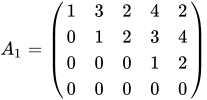
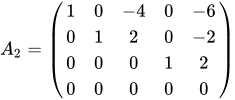
In Talk:06-240/Classnotes_For_Tuesday_November_14, User:Wongpak asked something about row echelon form and reduced row echelon form, and gave the following matrices as specific examples:
|
|
|
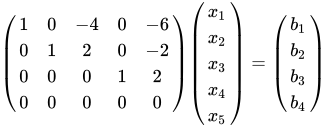
So let us assume row reduction leads us to the systems  or
or  . What does it tell us about the solutions? Let us start from the second system:
|
or
|

|
|

|
|

|

|

|
|
|

|

|
|

|
|

|
|
|
|
|

|

|
|

|
|
|
|
|
|

|
|

|
|
Well, quite clearly if  this system has no solutions, but if
  it has solutions no matter what , and are. Finally, for any given values of , and we can choose the values of
  and
and  (the variables corresponding the columns containing no pivots) as we please, and then get solutions by setting the "pivotal variables" in terms of the non-pivotal ones as follows:
  ,
,  and
and  .
.
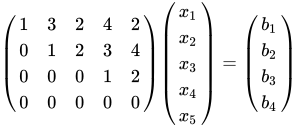
What about the system corresponding to  ? It is
|
or
|
|
|

|
|

|
|
|
|
|
|
|
|

|

|
|
|
|
|
|
|
|
|
|
|
|
|
|
|
|
|
|
|
|
Here too we have solutions iff , and if , we have the freedom to choose the non-pivotal variables and as we please. But now the formulas for fixing the pivotal variables , and in terms of the non-pivotal ones are a bit harder.
Class notes
Scan of Week 11 Lecture 1 notes
Lecture_notes november21st

