| #
|
Week of...
|
Notes and Links
|
| 1
|
Sep 11
|
About, Tue, HW1, Putnam, Thu
|
| 2
|
Sep 18
|
Tue, HW2, Thu
|
| 3
|
Sep 25
|
Tue, HW3, Photo, Thu
|
| 4
|
Oct 2
|
Tue, HW4, Thu
|
| 5
|
Oct 9
|
Tue, HW5, Thu
|
| 6
|
Oct 16
|
Why?, Iso, Tue, Thu
|
| 7
|
Oct 23
|
Term Test, Thu (double)
|
| 8
|
Oct 30
|
Tue, HW6, Thu
|
| 9
|
Nov 6
|
Tue, HW7, Thu
|
| 10
|
Nov 13
|
Tue, HW8, Thu
|
| 11
|
Nov 20
|
Tue, HW9, Thu
|
| 12
|
Nov 27
|
Tue, HW10, Thu
|
| 13
|
Dec 4
|
On the final, Tue, Thu
|
| F
|
Dec 11
|
Final: Dec 13 2-5PM at BN3, Exam Forum
|
| Register of Good Deeds
|

Add your name / see who's in!
|
| edit the panel
|
|
Review of Last Class
Problem. Find the rank (the dimension of the image) of a linear transformation  whose matrix representation is the matrix A shown on the right. whose matrix representation is the matrix A shown on the right.
|
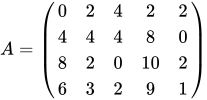 . .
|
Theorem 1. If  is a linear transformation and is a linear transformation and  and and  are invertible linear transformations, then the rank of is the same as the rank of are invertible linear transformations, then the rank of is the same as the rank of  . .
|
|
Proof. Owed.
|
Theorem 2. The following row/column operations can be applied to a matrix  by multiplying it on the left/right (respectively) by certain invertible "elementary matrices": by multiplying it on the left/right (respectively) by certain invertible "elementary matrices":
- Swap two rows/columns
- Multiply a row/column by a nonzero scalar.
- Add a multiple of one row/column to another row/column.
|
|
Proof. Semi-owed.
|
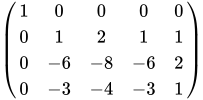
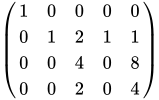
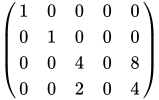
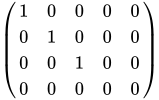
Solution of the problem. using these (invertible!) row/column operations we aim to bring to look as close as possible to an identity matrix, hoping it will be easy to determine the rank of the matrix we get at the end:
| Do
|
Get
|
Do
|
Get
|
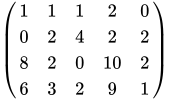
1. Bring a  to the upper left corner by swapping the first two rows and multiplying the first row (after the swap) by to the upper left corner by swapping the first two rows and multiplying the first row (after the swap) by  . .
|
|
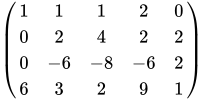
2. Add  times the first row to the third row, in order to cancel the times the first row to the third row, in order to cancel the  in position 3-1. in position 3-1.
|
|
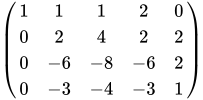
3. Likewise add  times the first row to the fourth row, in order to cancel the times the first row to the fourth row, in order to cancel the  in position 4-1. in position 4-1.
|
|
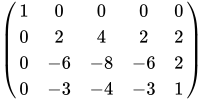
4. With similar column operations (you need three of those) cancel all the entries in the first row (except, of course, the first, which is used in the canceling).
|
|
5. Turn the 2-2 entry to a by multiplying the second row by  . .
|
|
6. Using two row operations "clean" the second column; that is, cancel all entries in it other than the "pivot" at position 2-2.
|
|
| 7. Using three column operations clean the second row except the pivot.
|
|
8. Clean up the row and the column of the  in position 3-3 by first multiplying the third row by and then performing the appropriate row and column transformations. Notice that by pure luck, the at position 4-5 of the matrix gets killed in action. in position 3-3 by first multiplying the third row by and then performing the appropriate row and column transformations. Notice that by pure luck, the at position 4-5 of the matrix gets killed in action.
|
|
But the matrix we now have represents a linear transformation  satisfying
  for some bases
  of
of  and
and  of
of  . Thus the image (range) of is spanned by
 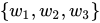 , and as these are independent, they form a basis of the image. Thus the rank of is
  . Going backward through the "matrix reduction" process above and repeatedly using theorems 1 and 2, we find that the rank of must also be .
Class Notes
Scan of Week 9 Lecture 2 notes
Tutorial Notes
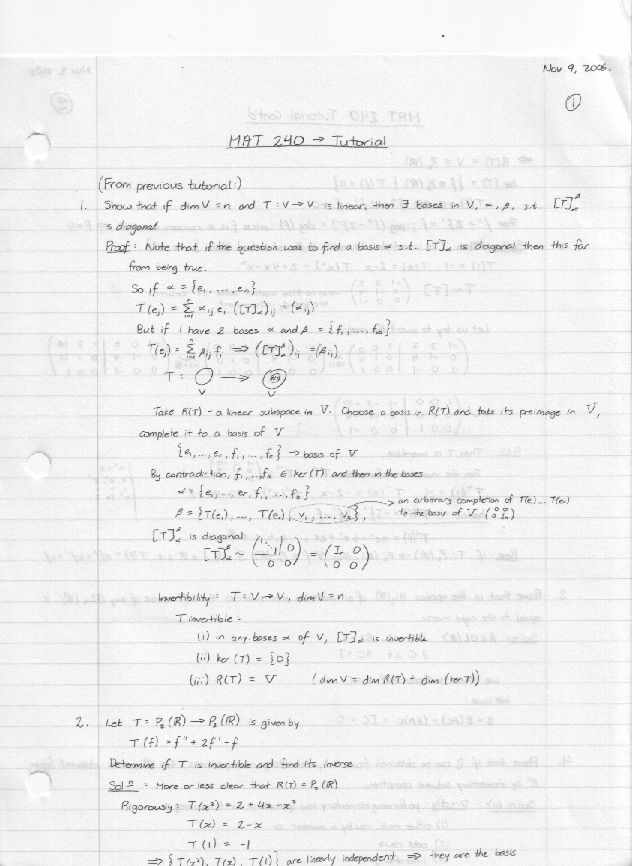
Nov09 Lecture notes 1 of 3
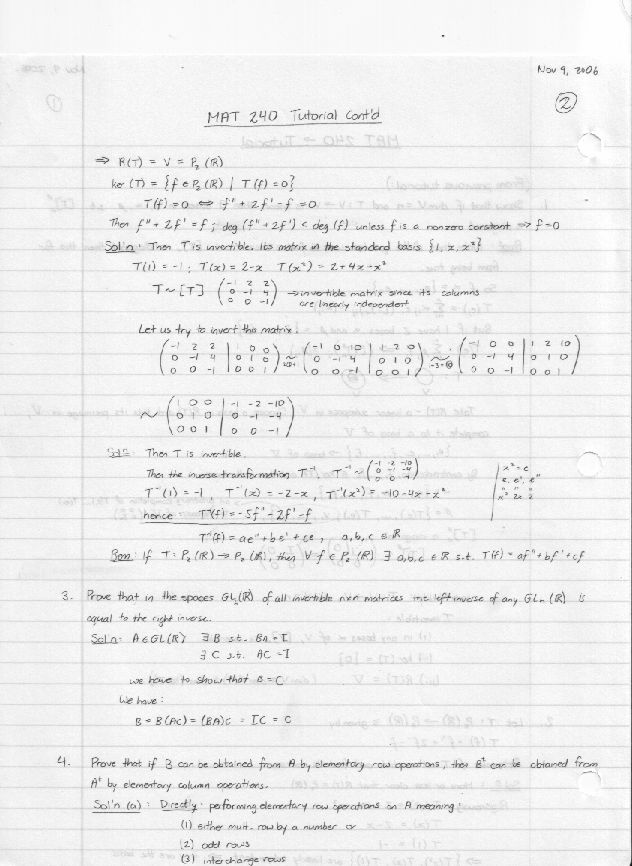
Nov09 Lecture notes 2 of 3
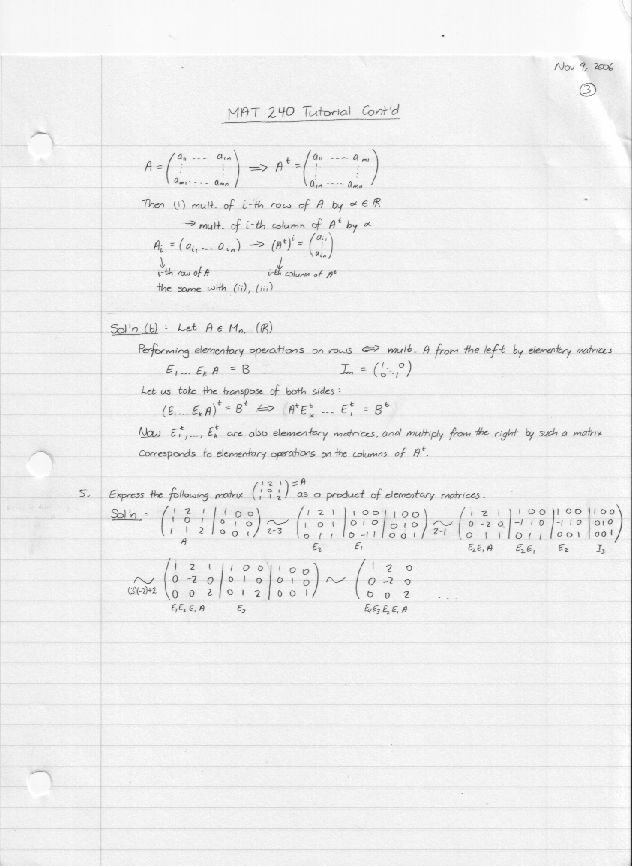
Nov09 Lecture notes 3 of 3
Scan of Week 9 Tutorial notes