12-240/Classnotes for Thursday September 13
| |||||||||||||||||||||||||||||||||||||||||||||||||||||||||


In the second day of the class, the professor continues on the definition of a field.
Definition of a field
Combined with a part from the first class, we have a complete definition as follow:
A field is a set "F' with two binary operations +,x defind on it, and two special elements 0 ≠ 1 such that
F1: commutative law
[math]\displaystyle{ \forall \!\, }[/math] a, b [math]\displaystyle{ \in \!\, }[/math] F: a+b=b+a and a.b=b.a
F2: associative law
[math]\displaystyle{ \forall \!\, }[/math] a, b, c [math]\displaystyle{ \in \!\, }[/math] F: (a+b)+c=a+(b+c) and (a.b).c= a.(b.c)
F3: the existence of identity elements
[math]\displaystyle{ \forall \!\, }[/math] a [math]\displaystyle{ \in \!\, }[/math], a+0=a and a.1=a
F4: existence of inverses
[math]\displaystyle{ \forall \!\, }[/math] a [math]\displaystyle{ \in \!\, }[/math] F \0,[math]\displaystyle{ \exists \!\, }[/math] c, d [math]\displaystyle{ \in \!\ }[/math] F such that a+c=o and a.d=1
F5: contributive law
[math]\displaystyle{ \forall \!\, }[/math] a, b, c [math]\displaystyle{ \in \!\, }[/math] F, a.(b+c)=a.b + a.c
Theorems
Cancellation laws [math]\displaystyle{ \forall \!\, }[/math] a, b, c [math]\displaystyle{ \in \!\, }[/math] F
if a+c=b+c, then a=b
if ac=bc and c[math]\displaystyle{ \ne \!\, }[/math]0, a=b
Significance
Identity uniqueness
It makes sense to define an operation -: F -> F called "negation"
For a [math]\displaystyle{ \in\!\, }[/math] F define -a to be equal that b [math]\displaystyle{ \in\!\, }[/math] F for which a+b=0, i.e, a+(-a)=0
Ex: F(5)={0,1,2,3,4}, define +,x
Question: What is(-3)?
Answer: -3=2
Lecture Notes, upload by Starash
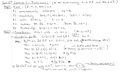
Page 1
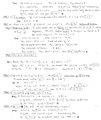
Page 2


