12-240/Classnotes for Tuesday October 16
| |||||||||||||||||||||||||||||||||||||||||||||||||||||||||


| Dror's notes above / Students' notes below |
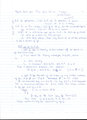
Theorems
1. If G generates, |G| [math]\displaystyle{ \ge \!\, }[/math] n and G contains a basis, |G|=n then G is a basis
2. If L is linearly independent, |L| [math]\displaystyle{ \le \!\, }[/math] n and L can be extended to be a basis. |L|=n => L is a basis.
3.W [math]\displaystyle{ \subset \!\, }[/math] V a subspace then W is finite dimensioned and dim W [math]\displaystyle{ \le \!\, }[/math] dim V
If dim W = dim V, then V = W If dim W < dim V, then any basis of W can be extended to be a basis of V
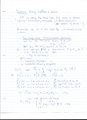
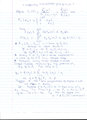
Proof of W is finite dimensioned:
Let L be a linearly independent subset of W which is of maximal size.
Fact about N
- Every subset A of N, which is:
1. Non empty
2. Bounded : [math]\displaystyle{ \exist \!\, }[/math] N [math]\displaystyle{ \in \!\, }[/math] N, [math]\displaystyle{ \forall \!\, }[/math] a [math]\displaystyle{ \in \!\, }[/math] A, a [math]\displaystyle{ \le \!\, }[/math] N
has a maximal element: an element m [math]\displaystyle{ \in \!\, }[/math] A, [math]\displaystyle{ \forall\!\, }[/math] a [math]\displaystyle{ \in \!\, }[/math] A, a [math]\displaystyle{ \le \!\, }[/math] m ( m + 1 [math]\displaystyle{ \notin \!\, }[/math] A )
class note
page1
page2
page3


