12-240/Classnotes for Tuesday October 09: Difference between revisions
Oguzhancan (talk | contribs) No edit summary |
|||
| Line 38: | Line 38: | ||
i.e ai = bi, hence the combination is unique. |
i.e ai = bi, hence the combination is unique. |
||
== Clarification on lecture notes == |
|||
On page 3, we find that <math>G \subseteq span(\beta)</math> then we say <math>span(G) \subseteq span(\beta)</math>. The reason is, the Theorem 1.5 in the textbook. |
|||
<b>Theorem 1.5:</b> The span of any subset <math>S</math> of a vector space <math>V</math> is a subspace of <math>V</math>. Moreover, any subspace of <math>V</math> that contains <math>S</math> must also contain <math>span(S)</math> |
|||
Since <math>\beta</math> is a subset of <math>V</math>, <math>span(\beta)</math> is a subspace of <math>V</math> from the first part of the Theorem 1.5. We have shown (in the lecture notes page 3) that <math>G \subseteq span(\beta)</math>. From the "Moreover" part of Theorem 1.5, since <math>span(\beta)</math> is a subspace of <math>V</math> containing <math>G</math>, <math>span(\beta)</math> must also contain <math>span(G)</math>. |
|||
== Lecture notes scanned by [[User:Oguzhancan|Oguzhancan]] == |
== Lecture notes scanned by [[User:Oguzhancan|Oguzhancan]] == |
||
Revision as of 01:07, 21 October 2012
| |||||||||||||||||||||||||||||||||||||||||||||||||||||||||


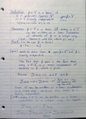
In this lecture, the professor concentrate on basics and related theorems.
Definition of basic
β [math]\displaystyle{ \subset \!\, }[/math] V is a basic if
1/ It generates ( span) V, span β = V
2/ It is linearly independent
theorems
1/ β is a basic of V iff every element of V can be written as a linear combination of elements of β in a unique way.
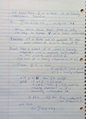
proof: ( in the case β is finite)
β = {u1, u2, ..., un}
(<=) need to show that β = span(V) and β is linearly independent.
The fact that β span is the fact that every element of V can be written as a linear combination of elements of β, which is given
Assume [math]\displaystyle{ \sum \!\, }[/math] ai.ui = 0 ai [math]\displaystyle{ \in\!\, }[/math] F, ui [math]\displaystyle{ \in\!\, }[/math] β
[math]\displaystyle{ \sum \!\, }[/math] ai.ui = 0 = [math]\displaystyle{ \sum \!\, }[/math] 0.ui
since 0 can be written as a linear combination of elements of β in a unique way, ai=0 [math]\displaystyle{ \forall\!\, }[/math] i
Hence β is linearly independent
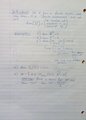
(=>) every element of V can be written as a linear combination of elements of β in a unique way.
So, suppose [math]\displaystyle{ \sum \!\, }[/math] ai.ui = v = [math]\displaystyle{ \sum \!\, }[/math] bi.ui
Thus [math]\displaystyle{ \sum \!\, }[/math] ai.ui - [math]\displaystyle{ \sum \!\, }[/math] bi.ui = 0
[math]\displaystyle{ \sum \!\, }[/math] (ai-bi).ui = 0
β is linear independent hence (ai - bi)= 0 [math]\displaystyle{ \forall\!\, }[/math] i
i.e ai = bi, hence the combination is unique.
Clarification on lecture notes
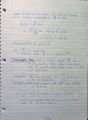
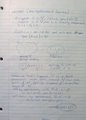
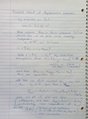
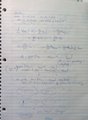
On page 3, we find that [math]\displaystyle{ G \subseteq span(\beta) }[/math] then we say [math]\displaystyle{ span(G) \subseteq span(\beta) }[/math]. The reason is, the Theorem 1.5 in the textbook.
Theorem 1.5: The span of any subset [math]\displaystyle{ S }[/math] of a vector space [math]\displaystyle{ V }[/math] is a subspace of [math]\displaystyle{ V }[/math]. Moreover, any subspace of [math]\displaystyle{ V }[/math] that contains [math]\displaystyle{ S }[/math] must also contain [math]\displaystyle{ span(S) }[/math]
Since [math]\displaystyle{ \beta }[/math] is a subset of [math]\displaystyle{ V }[/math], [math]\displaystyle{ span(\beta) }[/math] is a subspace of [math]\displaystyle{ V }[/math] from the first part of the Theorem 1.5. We have shown (in the lecture notes page 3) that [math]\displaystyle{ G \subseteq span(\beta) }[/math]. From the "Moreover" part of Theorem 1.5, since [math]\displaystyle{ span(\beta) }[/math] is a subspace of [math]\displaystyle{ V }[/math] containing [math]\displaystyle{ G }[/math], [math]\displaystyle{ span(\beta) }[/math] must also contain [math]\displaystyle{ span(G) }[/math].
Lecture notes scanned by Oguzhancan
Page 1
Page 2
Page 3
Page 4
Page 5
Page 6
Page 7


