12-240/Classnotes for Tuesday November 6: Difference between revisions
From Drorbn
Jump to navigationJump to search
No edit summary |
|||
| Line 10: | Line 10: | ||
2. For A <math>\in M_(m \times n)</math> and B <math>\in M_(n \times p)</math> and C <math>\in M_(p \times q)</math>, |
2. For A <math>\in M_(m \times n)</math> and B <math>\in M_(n \times p)</math> and C <math>\in M_(p \times q)</math>, |
||
(AB)C = |
(AB)C = A(BC) |
||
== Lecture notes scanned by [[User:Zetalda|Zetalda]] == |
== Lecture notes scanned by [[User:Zetalda|Zetalda]] == |
||
Latest revision as of 05:52, 7 December 2012
| |||||||||||||||||||||||||||||||||||||||||||||||||||||||||


Riddle
Find A and B such that AB - BA = I
Theorems
1. Given U with basis [math]\displaystyle{ \alpha }[/math], V with basis [math]\displaystyle{ \beta }[/math], W with basis [math]\displaystyle{ \gamma, }[/math] [math]\displaystyle{ [T \circ S]_\alpha^\beta = [T]_\beta^\gamma \times [S]_\alpha^\beta }[/math]
2. For A [math]\displaystyle{ \in M_(m \times n) }[/math] and B [math]\displaystyle{ \in M_(n \times p) }[/math] and C [math]\displaystyle{ \in M_(p \times q) }[/math], (AB)C = A(BC)
Lecture notes scanned by Zetalda
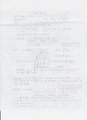
Page 1
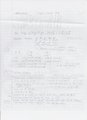
Page 2
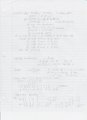
Page 3


