12-240/Classnotes for Tuesday November 15: Difference between revisions
From Drorbn
Jump to navigationJump to search
No edit summary |
No edit summary |
||
| (2 intermediate revisions by one other user not shown) | |||
| Line 7: | Line 7: | ||
{| border="1px" cellspadding="5" cellspacing=0 style="font-size:90%;" |
{| border="1px" cellspadding="5" cellspacing=0 style="font-size:90%;" |
||
|+ |
|+ |
||
|align=center|'''Do''' |
|||
|align=center|'''Get''' |
|||
|align=center|'''Do''' |
|align=center|'''Do''' |
||
|align=center|'''Get''' |
|align=center|'''Get''' |
||
| Line 14: | Line 12: | ||
|1. Bring a <math>1</math> to the upper left corner by swapping the first two rows and multiplying the first row (after the swap) by <math>1/4</math>. |
|1. Bring a <math>1</math> to the upper left corner by swapping the first two rows and multiplying the first row (after the swap) by <math>1/4</math>. |
||
|align=center|<math>\begin{pmatrix}1&1&1&2&0\\0&2&4&2&2\\8&2&0&10&2\\6&3&2&9&1\end{pmatrix}</math> |
|align=center|<math>\begin{pmatrix}1&1&1&2&0\\0&2&4&2&2\\8&2&0&10&2\\6&3&2&9&1\end{pmatrix}</math> |
||
|- valign=top |
|||
|2. Add <math>(-8)</math> times the first row to the third row, in order to cancel the <math>8</math> in position 3-1. |
|2. Add <math>(-8)</math> times the first row to the third row, in order to cancel the <math>8</math> in position 3-1. |
||
|align=center|<math>\begin{pmatrix}1&1&1&2&0\\0&2&4&2&2\\0&-6&-8&-6&2\\6&3&2&9&1\end{pmatrix}</math> |
|align=center|<math>\begin{pmatrix}1&1&1&2&0\\0&2&4&2&2\\0&-6&-8&-6&2\\6&3&2&9&1\end{pmatrix}</math> |
||
| Line 19: | Line 18: | ||
|3. Likewise add <math>(-6)</math> times the first row to the fourth row, in order to cancel the <math>6</math> in position 4-1. |
|3. Likewise add <math>(-6)</math> times the first row to the fourth row, in order to cancel the <math>6</math> in position 4-1. |
||
|align=center|<math>\begin{pmatrix}1&1&1&2&0\\0&2&4&2&2\\0&-6&-8&-6&2\\0&-3&-4&-3&1\end{pmatrix}</math> |
|align=center|<math>\begin{pmatrix}1&1&1&2&0\\0&2&4&2&2\\0&-6&-8&-6&2\\0&-3&-4&-3&1\end{pmatrix}</math> |
||
|- valign=top |
|||
|4. With similar column operations (you need three of those) cancel all the entries in the first row (except, of course, the first, which is used in the canceling). |
|4. With similar column operations (you need three of those) cancel all the entries in the first row (except, of course, the first, which is used in the canceling). |
||
|align=center|<math>\begin{pmatrix}1&0&0&0&0\\0&2&4&2&2\\0&-6&-8&-6&2\\0&-3&-4&-3&1\end{pmatrix}</math> |
|align=center|<math>\begin{pmatrix}1&0&0&0&0\\0&2&4&2&2\\0&-6&-8&-6&2\\0&-3&-4&-3&1\end{pmatrix}</math> |
||
| Line 24: | Line 24: | ||
|5. Turn the 2-2 entry to a <math>1</math> by multiplying the second row by <math>1/2</math>. |
|5. Turn the 2-2 entry to a <math>1</math> by multiplying the second row by <math>1/2</math>. |
||
|align=center|<math>\begin{pmatrix}1&0&0&0&0\\0&1&2&1&1\\0&-6&-8&-6&2\\0&-3&-4&-3&1\end{pmatrix}</math> |
|align=center|<math>\begin{pmatrix}1&0&0&0&0\\0&1&2&1&1\\0&-6&-8&-6&2\\0&-3&-4&-3&1\end{pmatrix}</math> |
||
|- valign=top |
|||
|6. Using two row operations "clean" the second column; that is, cancel all entries in it other than the "pivot" <math>1</math> at position 2-2. |
|6. Using two row operations "clean" the second column; that is, cancel all entries in it other than the "pivot" <math>1</math> at position 2-2. |
||
|align=center|<math>\begin{pmatrix}1&0&0&0&0\\0&1&2&1&1\\0&0&4&0&8\\0&0&2&0&4\end{pmatrix}</math> |
|align=center|<math>\begin{pmatrix}1&0&0&0&0\\0&1&2&1&1\\0&0&4&0&8\\0&0&2&0&4\end{pmatrix}</math> |
||
| Line 29: | Line 30: | ||
|7. Using three column operations clean the second row except the pivot. |
|7. Using three column operations clean the second row except the pivot. |
||
|align=center|<math>\begin{pmatrix}1&0&0&0&0\\0&1&0&0&0\\0&0&4&0&8\\0&0&2&0&4\end{pmatrix}</math> |
|align=center|<math>\begin{pmatrix}1&0&0&0&0\\0&1&0&0&0\\0&0&4&0&8\\0&0&2&0&4\end{pmatrix}</math> |
||
|- valign=top |
|||
|8. Clean up the row and the column of the <math>4</math> in position 3-3 by first multiplying the third row by <math>1/4</math> and then performing the appropriate row and column transformations. Notice that by pure luck, the <math>4</math> at position 4-5 of the matrix gets killed in action. |
|8. Clean up the row and the column of the <math>4</math> in position 3-3 by first multiplying the third row by <math>1/4</math> and then performing the appropriate row and column transformations. Notice that by pure luck, the <math>4</math> at position 4-5 of the matrix gets killed in action. |
||
|align=center|<math>\begin{pmatrix}1&0&0&0&0\\0&1&0&0&0\\0&0&1&0&0\\0&0&0&0&0\end{pmatrix}</math> |
|align=center|<math>\begin{pmatrix}1&0&0&0&0\\0&1&0&0&0\\0&0&1&0&0\\0&0&0&0&0\end{pmatrix}</math> |
||
|} |
|} |
||
Thus the rank of our matrix is 3. |
Thus the rank of our matrix is 3. |
||
== Lecture notes scanned by [[User:Zetalda|Zetalda]] == |
|||
<gallery> |
|||
Image:12-240-Nov15-1.jpeg|Page 1 |
|||
Image:12-240-Nov15-2.jpeg|Page 2 |
|||
</gallery> |
|||
Latest revision as of 21:42, 15 November 2012
| |||||||||||||||||||||||||||||||||||||||||||||||||||||||||


Problem. Find the rank the matrix
Solution. Using (invertible!) row/column operations we aim to bring [math]\displaystyle{ A }[/math] to look as close as possible to an identity matrix:
| Do | Get |
| 1. Bring a [math]\displaystyle{ 1 }[/math] to the upper left corner by swapping the first two rows and multiplying the first row (after the swap) by [math]\displaystyle{ 1/4 }[/math]. | [math]\displaystyle{ \begin{pmatrix}1&1&1&2&0\\0&2&4&2&2\\8&2&0&10&2\\6&3&2&9&1\end{pmatrix} }[/math] |
| 2. Add [math]\displaystyle{ (-8) }[/math] times the first row to the third row, in order to cancel the [math]\displaystyle{ 8 }[/math] in position 3-1. | [math]\displaystyle{ \begin{pmatrix}1&1&1&2&0\\0&2&4&2&2\\0&-6&-8&-6&2\\6&3&2&9&1\end{pmatrix} }[/math] |
| 3. Likewise add [math]\displaystyle{ (-6) }[/math] times the first row to the fourth row, in order to cancel the [math]\displaystyle{ 6 }[/math] in position 4-1. | [math]\displaystyle{ \begin{pmatrix}1&1&1&2&0\\0&2&4&2&2\\0&-6&-8&-6&2\\0&-3&-4&-3&1\end{pmatrix} }[/math] |
| 4. With similar column operations (you need three of those) cancel all the entries in the first row (except, of course, the first, which is used in the canceling). | [math]\displaystyle{ \begin{pmatrix}1&0&0&0&0\\0&2&4&2&2\\0&-6&-8&-6&2\\0&-3&-4&-3&1\end{pmatrix} }[/math] |
| 5. Turn the 2-2 entry to a [math]\displaystyle{ 1 }[/math] by multiplying the second row by [math]\displaystyle{ 1/2 }[/math]. | [math]\displaystyle{ \begin{pmatrix}1&0&0&0&0\\0&1&2&1&1\\0&-6&-8&-6&2\\0&-3&-4&-3&1\end{pmatrix} }[/math] |
| 6. Using two row operations "clean" the second column; that is, cancel all entries in it other than the "pivot" [math]\displaystyle{ 1 }[/math] at position 2-2. | [math]\displaystyle{ \begin{pmatrix}1&0&0&0&0\\0&1&2&1&1\\0&0&4&0&8\\0&0&2&0&4\end{pmatrix} }[/math] |
| 7. Using three column operations clean the second row except the pivot. | [math]\displaystyle{ \begin{pmatrix}1&0&0&0&0\\0&1&0&0&0\\0&0&4&0&8\\0&0&2&0&4\end{pmatrix} }[/math] |
| 8. Clean up the row and the column of the [math]\displaystyle{ 4 }[/math] in position 3-3 by first multiplying the third row by [math]\displaystyle{ 1/4 }[/math] and then performing the appropriate row and column transformations. Notice that by pure luck, the [math]\displaystyle{ 4 }[/math] at position 4-5 of the matrix gets killed in action. | [math]\displaystyle{ \begin{pmatrix}1&0&0&0&0\\0&1&0&0&0\\0&0&1&0&0\\0&0&0&0&0\end{pmatrix} }[/math] |
Thus the rank of our matrix is 3.
Lecture notes scanned by Zetalda
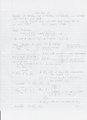
Page 1

Page 2


