12-240/Classnotes for Tuesday October 16: Difference between revisions
No edit summary |
No edit summary |
||
| Line 1: | Line 1: | ||
{{12-240/Navigation}} |
{{12-240/Navigation}} |
||
===Riddle Along=== |
|||
The game of 15 is played as follows. Two players alternate choosing cards numbered between 1 and 9, with repetitions forbidden, so that the game ends at most after 9 moves (or four and a half rounds). The first player to have within her/his cards a set of precisely 3 cards that add up to 15 wins. |
|||
Does this game have a winning strategy? What is it? Who wins, the first to move or the second? Why am I asking this question at this particular time? |
|||
[[Image:12-240-DeckOfCards.png|center]] |
|||
See also [https://media.library.utoronto.ca/play.php?DJ6CPFxByy2J&id=8503 a video] and the [https://cmc.math.ca/home/videos/game-of-15-and-isomorphisms/ transcript] of that video. |
|||
{{12-240:Dror/Students Divider}} |
{{12-240:Dror/Students Divider}} |
||
Latest revision as of 21:41, 12 December 2012
| |||||||||||||||||||||||||||||||||||||||||||||||||||||||||


| Dror's notes above / Students' notes below |
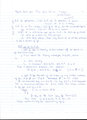
Theorems
1. If G generates, |G| [math]\displaystyle{ \ge \!\, }[/math] n and G contains a basis, |G|=n then G is a basis
2. If L is linearly independent, |L| [math]\displaystyle{ \le \!\, }[/math] n and L can be extended to be a basis. |L|=n => L is a basis.
3.W [math]\displaystyle{ \subset \!\, }[/math] V a subspace then W is finite dimensioned and dim W [math]\displaystyle{ \le \!\, }[/math] dim V
If dim W = dim V, then V = W If dim W < dim V, then any basis of W can be extended to be a basis of V
Proof of W is finite dimensioned:
Let L be a linearly independent subset of W which is of maximal size.
Fact about N
- Every subset A of N, which is:
1. Non empty
2. Bounded : [math]\displaystyle{ \exist \!\, }[/math] N [math]\displaystyle{ \in \!\, }[/math] N, [math]\displaystyle{ \forall \!\, }[/math] a [math]\displaystyle{ \in \!\, }[/math] A, a [math]\displaystyle{ \le \!\, }[/math] N
has a maximal element: an element m [math]\displaystyle{ \in \!\, }[/math] A, [math]\displaystyle{ \forall\!\, }[/math] a [math]\displaystyle{ \in \!\, }[/math] A, a [math]\displaystyle{ \le \!\, }[/math] m ( m + 1 [math]\displaystyle{ \notin \!\, }[/math] A )
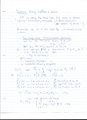
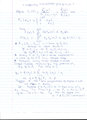
class note
page1
page2
page3


