12-267/Homework Assignment 1: Difference between revisions
(Changed format of Mathstudent's solutions to a gallery) |
m (Added student divider) |
||
| Line 15: | Line 15: | ||
# <math>0=(e^x\sin y + 3y)dx + (3(x+y)+e^x\cos y)dy</math>. |
# <math>0=(e^x\sin y + 3y)dx + (3(x+y)+e^x\cos y)dy</math>. |
||
{{Template:12-267:Dror/Students Divider}} |
|||
Disclamer: The solutions below are by students, for students. |
|||
'''Solution to Question 1.''' [[User:Twine|Twine]] |
'''Solution to Question 1.''' [[User:Twine|Twine]] |
||
Latest revision as of 17:05, 24 October 2012
| ||||||||||||||||||||||||||||||||||||||||||||||||||||||||||||


This assignment is due at the tutorial on Tuesday September 25. Here and everywhere, neatness counts!! You may be brilliant and you may mean just the right things, but if the your readers will be having hard time deciphering your work they will give up and assume it is wrong.
Question 1. Show that if [math]\displaystyle{ y=y_1(x) }[/math] is a solution of [math]\displaystyle{ y'+p(x)y=0 }[/math], and [math]\displaystyle{ y=y_2(x) }[/math] is a solution of [math]\displaystyle{ y'+p(x)y=g(x) }[/math], then for any constant [math]\displaystyle{ c }[/math], [math]\displaystyle{ y=cy_1+y_2 }[/math] is a solution of [math]\displaystyle{ y'+p(x)y=g(x) }[/math].
Question 2. Solve the following differential equations
- For [math]\displaystyle{ x\gt 0 }[/math], [math]\displaystyle{ xy'+2y=\sin x }[/math].
- [math]\displaystyle{ \frac{dy}{dx}=\frac{1}{e^y-x} }[/math] with [math]\displaystyle{ y(1)=0 }[/math]; you may want to solve for [math]\displaystyle{ x }[/math] first.
- [math]\displaystyle{ xy'=\sqrt{1-y^2} }[/math].
- [math]\displaystyle{ \frac{dy}{dx}=\frac{x-e^{-x}}{y+e^y} }[/math].
- [math]\displaystyle{ xdx+ye^{-x}dy=0 }[/math], with [math]\displaystyle{ y(0)=1 }[/math].
- [math]\displaystyle{ \frac{dy}{dx}=\frac{ay+b}{cx+d} }[/math], where [math]\displaystyle{ a,b,c,d }[/math] are arbitrary constants.
- [math]\displaystyle{ \frac{dy}{dx}=-\frac{ax+by}{bx+cy} }[/math], where [math]\displaystyle{ a,b,c }[/math] are arbitrary constants.
- [math]\displaystyle{ 0=(e^x\sin y + 3y)dx + (3(x+y)+e^x\cos y)dy }[/math].
| Dror's notes above / Student's notes below |
Solution to Question 1. Twine
Take y defined by [math]\displaystyle{ y=cy_1+y_2 }[/math] and plug it into [math]\displaystyle{ y'+p(x)y=g(x) }[/math]. We get
[math]\displaystyle{ (cy_1 + y_2)' + p(x)(cy_1 + y_2) = g(x) }[/math]
[math]\displaystyle{ c(y_1' + p(x)y_1) + (y_2' + p(x)y_2) = g(x) }[/math]
Based on our assumptions about [math]\displaystyle{ y_1 }[/math] and [math]\displaystyle{ y_2 }[/math], we have [math]\displaystyle{ y_1' + p(x)y_1 = 0 }[/math] and we have [math]\displaystyle{ y_2' + p(x)y_2 = g(x) }[/math], and so the above equation holds [math]\displaystyle{ \forall c \in \mathbb{R} }[/math].
Hence, [math]\displaystyle{ \forall c \in \mathbb{R} }[/math], [math]\displaystyle{ cy_1 + y_2 }[/math] is a solution of [math]\displaystyle{ y'+p(x)y=g(x) }[/math].
Solutions to HW1: Mathstudent
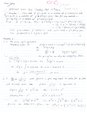
page 1
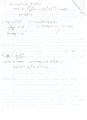
page 2
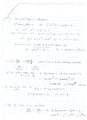
page 3
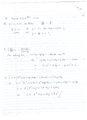
page 4


