| #
|
Week of...
|
Notes and Links
|
| 1
|
Sep 11
|
About, Tue, HW1, Putnam, Thu
|
| 2
|
Sep 18
|
Tue, HW2, Thu
|
| 3
|
Sep 25
|
Tue, HW3, Photo, Thu
|
| 4
|
Oct 2
|
Tue, HW4, Thu
|
| 5
|
Oct 9
|
Tue, HW5, Thu
|
| 6
|
Oct 16
|
Why?, Iso, Tue, Thu
|
| 7
|
Oct 23
|
Term Test, Thu (double)
|
| 8
|
Oct 30
|
Tue, HW6, Thu
|
| 9
|
Nov 6
|
Tue, HW7, Thu
|
| 10
|
Nov 13
|
Tue, HW8, Thu
|
| 11
|
Nov 20
|
Tue, HW9, Thu
|
| 12
|
Nov 27
|
Tue, HW10, Thu
|
| 13
|
Dec 4
|
On the final, Tue, Thu
|
| F
|
Dec 11
|
Final: Dec 13 2-5PM at BN3, Exam Forum
|
| Register of Good Deeds
|
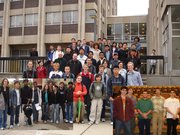
Add your name / see who's in!
|
| edit the panel
|
|
Review of Last Class
| Problem. Find the rank (the dimension of the image) of a linear transformation [math]\displaystyle{ T }[/math] whose matrix representation is the matrix A shown on the right.
|
[math]\displaystyle{ A=\begin{pmatrix}0&2&4&2&2\\4&4&4&8&0\\8&2&0&10&2\\6&3&2&9&1\end{pmatrix} }[/math].
|
| Theorem 1. If [math]\displaystyle{ T:V\to W }[/math] is a linear transformation and [math]\displaystyle{ P:V\to V }[/math] and [math]\displaystyle{ Q:W\to W }[/math] are invertible linear transformations, then the rank of [math]\displaystyle{ T }[/math] is the same as the rank of [math]\displaystyle{ QTP }[/math].
|
|
Proof. Owed.
|
Theorem 2. The following row/column operations can be applied to a matrix [math]\displaystyle{ A }[/math] by multiplying it on the left/right (respectively) by certain invertible "elementary matrices":
- Swap two rows/columns
- Multiply a row/column by a nonzero scalar.
- Add a multiple of one row/column to another row/column.
|
|
Proof. Semi-owed.
|
Solution of the problem. using these (invertible!) row/column operations we aim to bring [math]\displaystyle{ A }[/math] to look as close as possible to an identity matrix, hoping it will be easy to determine the rank of the matrix we get at the end:
| Do
|
Get
|
Do
|
Get
|
| 1. Bring a [math]\displaystyle{ 1 }[/math] to the upper left corner by swapping the first two rows and multiplying the first row (after the swap) by [math]\displaystyle{ 1/4 }[/math].
|
[math]\displaystyle{ \begin{pmatrix}1&1&1&2&0\\0&2&4&2&2\\8&2&0&10&2\\6&3&2&9&1\end{pmatrix} }[/math]
|
2. Add [math]\displaystyle{ (-8) }[/math] times the first row to the third row, in order to cancel the [math]\displaystyle{ 8 }[/math] in position 3-1.
|
[math]\displaystyle{ \begin{pmatrix}1&1&1&2&0\\0&2&4&2&2\\0&-6&-8&-6&2\\6&3&2&9&1\end{pmatrix} }[/math]
|
| 3. Likewise add [math]\displaystyle{ (-6) }[/math] times the first row to the fourth row, in order to cancel the [math]\displaystyle{ 6 }[/math] in position 4-1.
|
[math]\displaystyle{ \begin{pmatrix}1&1&1&2&0\\0&2&4&2&2\\0&-6&-8&-6&2\\0&-3&-4&-3&1\end{pmatrix} }[/math]
|
4. With similar column operations (you need three of those) cancel all the entries in the first row (except, of course, the first, which is used in the canceling).
|
[math]\displaystyle{ \begin{pmatrix}1&0&0&0&0\\0&2&4&2&2\\0&-6&-8&-6&2\\0&-3&-4&-3&1\end{pmatrix} }[/math]
|
| 5. Turn the 2-2 entry to a [math]\displaystyle{ 1 }[/math] by multiplying the second row by [math]\displaystyle{ 1/2 }[/math].
|
[math]\displaystyle{ \begin{pmatrix}1&0&0&0&0\\0&1&2&1&1\\0&-6&-8&-6&2\\0&-3&-4&-3&1\end{pmatrix} }[/math]
|
6. Using two row operations "clean" the second column; that is, cancel all entries in it other than the "pivot" [math]\displaystyle{ 1 }[/math] at position 2-2.
|
[math]\displaystyle{ \begin{pmatrix}1&0&0&0&0\\0&1&2&1&1\\0&0&4&0&8\\0&0&2&0&4\end{pmatrix} }[/math]
|
| 7. Using three column operations clean the second row except the pivot.
|
[math]\displaystyle{ \begin{pmatrix}1&0&0&0&0\\0&1&0&0&0\\0&0&4&0&8\\0&0&2&0&4\end{pmatrix} }[/math]
|
8. Clean up the row and the column of the [math]\displaystyle{ 4 }[/math] in position 3-3 by first multiplying the third row by [math]\displaystyle{ 1/4 }[/math] and then performing the appropriate row and column transformations. Notice that by pure luck, the [math]\displaystyle{ 4 }[/math] at position 4-5 of the matrix gets killed in action.
|
[math]\displaystyle{ \begin{pmatrix}1&0&0&0&0\\0&1&0&0&0\\0&0&1&0&0\\0&0&0&0&0\end{pmatrix} }[/math]
|
But the matrix we now have represents a linear transformation [math]\displaystyle{ S }[/math] satisfying [math]\displaystyle{ S(v_1,\,v_2,\,v_3,\,v_4\,v_5)=(w_1,\,w_2,\,w_3,\,0,\,0) }[/math] for some bases [math]\displaystyle{ (v_i)_{i=1}^5 }[/math] of [math]\displaystyle{ V }[/math] and [math]\displaystyle{ (w_j)_{j=1}^4 }[/math] of [math]\displaystyle{ W }[/math]. Thus the image (range) of [math]\displaystyle{ S }[/math] is spanned by [math]\displaystyle{ \{w_1,w_2,w_3\} }[/math], and as these are independent, they form a basis of the image. Thus the rank of [math]\displaystyle{ S }[/math] is [math]\displaystyle{ 3 }[/math]. Going backward through the "matrix reduction" process above and repeatedly using theorems 1 and 2, we find that the rank of [math]\displaystyle{ T }[/math] must also be [math]\displaystyle{ 3 }[/math].

