06-240/Classnotes For Thursday November 9: Difference between revisions
No edit summary |
m (Reverted edit of 76.98.229.83, changed back to last version by Alla) |
||
| (12 intermediate revisions by 6 users not shown) | |||
| Line 2: | Line 2: | ||
==Review of Last Class== |
==Review of Last Class== |
||
{| |
{| |
||
|- |
|- |
||
| Line 9: | Line 8: | ||
|} |
|} |
||
{| |
|||
| ⚫ | |||
|- valign=bottom |
|||
| ⚫ | |||
| ⚫ | |||
| |
|||
| ⚫ | |||
| ⚫ | |||
|- valign=bottom |
|||
| ⚫ | |||
# Swap two rows/columns |
# Swap two rows/columns |
||
# Multiply a row/column by a scalar. |
# Multiply a row/column by a nonzero scalar. |
||
# Add a multiple of one row/column to another row/column. |
# Add a multiple of one row/column to another row/column. |
||
| |
|||
'''Proof.''' Semi-owed. |
|'''Proof.''' Semi-owed. |
||
|} |
|||
'''Solution of the problem.''' using these (invertible!) row/column operations we aim to bring <math>A</math> to look as close as possible to an identity matrix, hoping it will be easy to determine the rank of the matrix we get at the end: |
'''Solution of the problem.''' using these (invertible!) row/column operations we aim to bring <math>A</math> to look as close as possible to an identity matrix, hoping it will be easy to determine the rank of the matrix we get at the end: |
||
{| border="1px" cellspadding="5" cellspacing=0 |
{| border="1px" cellspadding="5" cellspacing=0 style="font-size:90%;" |
||
|+ |
|+ |
||
|align=center|'''Do''' |
|align=center|'''Do''' |
||
| Line 44: | Line 46: | ||
|align=center|<math>\begin{pmatrix}1&0&0&0&0\\0&1&2&1&1\\0&0&4&0&8\\0&0&2&0&4\end{pmatrix}</math> |
|align=center|<math>\begin{pmatrix}1&0&0&0&0\\0&1&2&1&1\\0&0&4&0&8\\0&0&2&0&4\end{pmatrix}</math> |
||
|- valign=top |
|- valign=top |
||
|7. Using three |
|7. Using three column operations clean the second row except the pivot. |
||
|align=center|<math>\begin{pmatrix}1&0&0&0&0\\0&1&0&0&0\\0&0&4&0&8\\0&0&2&0&4\end{pmatrix}</math> |
|align=center|<math>\begin{pmatrix}1&0&0&0&0\\0&1&0&0&0\\0&0&4&0&8\\0&0&2&0&4\end{pmatrix}</math> |
||
|8. Clean up the row and the column of the <math>4</math> in position 3-3 by first multiplying the third row by <math>1/4</math> and then performing the appropriate row and column transformations. Notice that by pure luck, the <math>4</math> at position 4-5 of the matrix gets killed in action. |
|8. Clean up the row and the column of the <math>4</math> in position 3-3 by first multiplying the third row by <math>1/4</math> and then performing the appropriate row and column transformations. Notice that by pure luck, the <math>4</math> at position 4-5 of the matrix gets killed in action. |
||
| Line 51: | Line 53: | ||
But the matrix we now have represents a linear transformation <math>S</math> satisfying <math>S(v_1,\,v_2,\,v_3,\,v_4\,v_5)=(w_1,\,w_2,\,w_3,\,0,\,0)</math> for some bases <math>(v_i)_{i=1}^5</math> of <math>V</math> and <math>(w_j)_{j=1}^4</math> of <math>W</math>. Thus the image (range) of <math>S</math> is spanned by <math>\{w_1,w_2,w_3\}</math>, and as these are independent, they form a basis of the image. Thus the rank of <math>S</math> is <math>3</math>. Going backward through the "matrix reduction" process above and repeatedly using theorems 1 and 2, we find that the rank of <math>T</math> must also be <math>3</math>. |
But the matrix we now have represents a linear transformation <math>S</math> satisfying <math>S(v_1,\,v_2,\,v_3,\,v_4\,v_5)=(w_1,\,w_2,\,w_3,\,0,\,0)</math> for some bases <math>(v_i)_{i=1}^5</math> of <math>V</math> and <math>(w_j)_{j=1}^4</math> of <math>W</math>. Thus the image (range) of <math>S</math> is spanned by <math>\{w_1,w_2,w_3\}</math>, and as these are independent, they form a basis of the image. Thus the rank of <math>S</math> is <math>3</math>. Going backward through the "matrix reduction" process above and repeatedly using theorems 1 and 2, we find that the rank of <math>T</math> must also be <math>3</math>. |
||
==Class Notes== |
|||
[[Media:Lect015.pdf|Scan of Week 9 Lecture 2 notes]] |
|||
==Tutorial Notes== |
|||
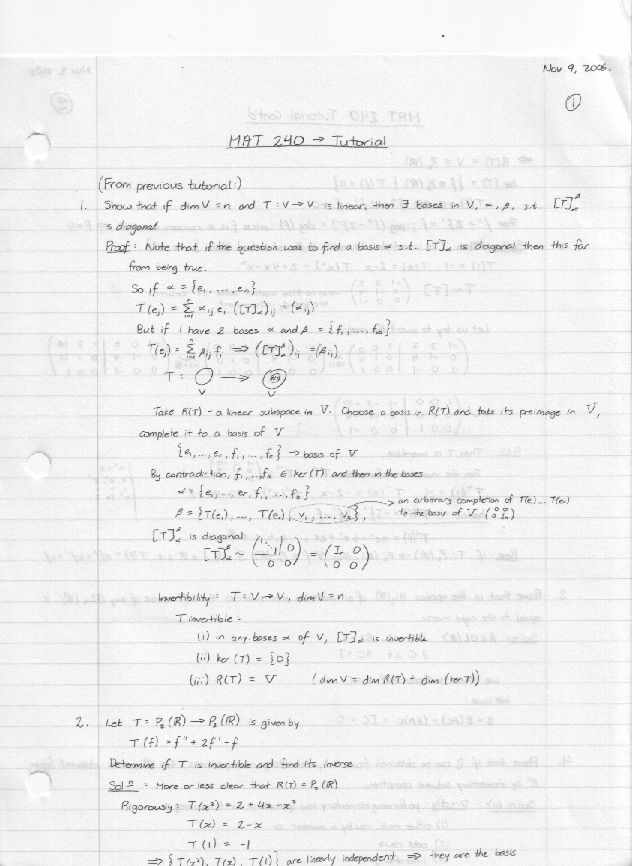
[[Media:06-240-nov09tut-1.jpeg|Nov09 Lecture notes 1 of 3]] |
|||
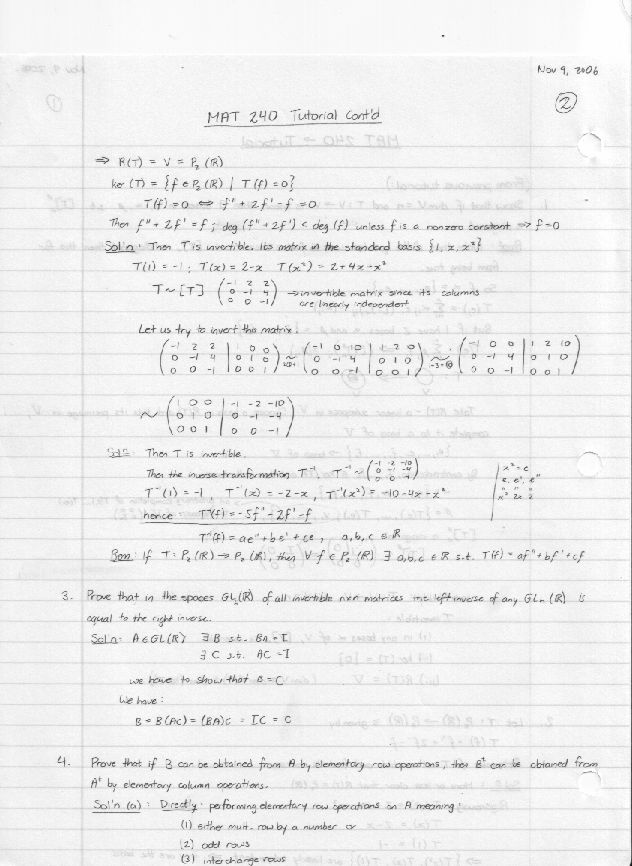
[[Media:06-240-nov09tut-2.jpeg|Nov09 Lecture notes 2 of 3]] |
|||
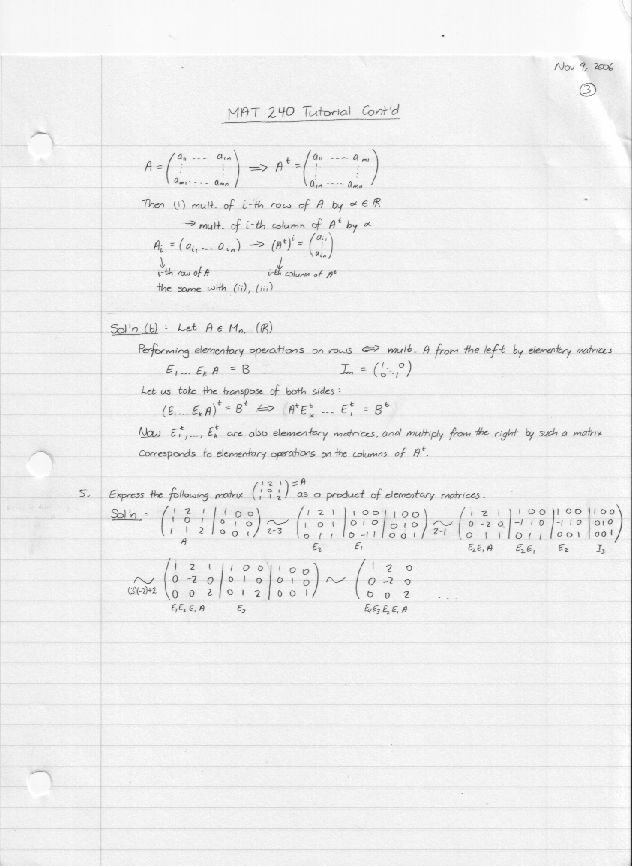
[[Media:06-240-nov09tut-3.jpeg|Nov09 Lecture notes 3 of 3]] |
|||
[[Media:Tut009.pdf|Scan of Week 9 Tutorial notes]] |
|||
Latest revision as of 10:50, 28 May 2007
| ||||||||||||||||||||||||||||||||||||||||||||||||||||||

Review of Last Class
| Problem. Find the rank (the dimension of the image) of a linear transformation [math]\displaystyle{ T }[/math] whose matrix representation is the matrix A shown on the right. | [math]\displaystyle{ A=\begin{pmatrix}0&2&4&2&2\\4&4&4&8&0\\8&2&0&10&2\\6&3&2&9&1\end{pmatrix} }[/math]. |
| Theorem 1. If [math]\displaystyle{ T:V\to W }[/math] is a linear transformation and [math]\displaystyle{ P:V\to V }[/math] and [math]\displaystyle{ Q:W\to W }[/math] are invertible linear transformations, then the rank of [math]\displaystyle{ T }[/math] is the same as the rank of [math]\displaystyle{ QTP }[/math]. | Proof. Owed. | |
Theorem 2. The following row/column operations can be applied to a matrix [math]\displaystyle{ A }[/math] by multiplying it on the left/right (respectively) by certain invertible "elementary matrices":
|
Proof. Semi-owed. |
Solution of the problem. using these (invertible!) row/column operations we aim to bring [math]\displaystyle{ A }[/math] to look as close as possible to an identity matrix, hoping it will be easy to determine the rank of the matrix we get at the end:
| Do | Get | Do | Get |
| 1. Bring a [math]\displaystyle{ 1 }[/math] to the upper left corner by swapping the first two rows and multiplying the first row (after the swap) by [math]\displaystyle{ 1/4 }[/math]. | [math]\displaystyle{ \begin{pmatrix}1&1&1&2&0\\0&2&4&2&2\\8&2&0&10&2\\6&3&2&9&1\end{pmatrix} }[/math] | 2. Add [math]\displaystyle{ (-8) }[/math] times the first row to the third row, in order to cancel the [math]\displaystyle{ 8 }[/math] in position 3-1. | [math]\displaystyle{ \begin{pmatrix}1&1&1&2&0\\0&2&4&2&2\\0&-6&-8&-6&2\\6&3&2&9&1\end{pmatrix} }[/math] |
| 3. Likewise add [math]\displaystyle{ (-6) }[/math] times the first row to the fourth row, in order to cancel the [math]\displaystyle{ 6 }[/math] in position 4-1. | [math]\displaystyle{ \begin{pmatrix}1&1&1&2&0\\0&2&4&2&2\\0&-6&-8&-6&2\\0&-3&-4&-3&1\end{pmatrix} }[/math] | 4. With similar column operations (you need three of those) cancel all the entries in the first row (except, of course, the first, which is used in the canceling). | [math]\displaystyle{ \begin{pmatrix}1&0&0&0&0\\0&2&4&2&2\\0&-6&-8&-6&2\\0&-3&-4&-3&1\end{pmatrix} }[/math] |
| 5. Turn the 2-2 entry to a [math]\displaystyle{ 1 }[/math] by multiplying the second row by [math]\displaystyle{ 1/2 }[/math]. | [math]\displaystyle{ \begin{pmatrix}1&0&0&0&0\\0&1&2&1&1\\0&-6&-8&-6&2\\0&-3&-4&-3&1\end{pmatrix} }[/math] | 6. Using two row operations "clean" the second column; that is, cancel all entries in it other than the "pivot" [math]\displaystyle{ 1 }[/math] at position 2-2. | [math]\displaystyle{ \begin{pmatrix}1&0&0&0&0\\0&1&2&1&1\\0&0&4&0&8\\0&0&2&0&4\end{pmatrix} }[/math] |
| 7. Using three column operations clean the second row except the pivot. | [math]\displaystyle{ \begin{pmatrix}1&0&0&0&0\\0&1&0&0&0\\0&0&4&0&8\\0&0&2&0&4\end{pmatrix} }[/math] | 8. Clean up the row and the column of the [math]\displaystyle{ 4 }[/math] in position 3-3 by first multiplying the third row by [math]\displaystyle{ 1/4 }[/math] and then performing the appropriate row and column transformations. Notice that by pure luck, the [math]\displaystyle{ 4 }[/math] at position 4-5 of the matrix gets killed in action. | [math]\displaystyle{ \begin{pmatrix}1&0&0&0&0\\0&1&0&0&0\\0&0&1&0&0\\0&0&0&0&0\end{pmatrix} }[/math] |
But the matrix we now have represents a linear transformation [math]\displaystyle{ S }[/math] satisfying [math]\displaystyle{ S(v_1,\,v_2,\,v_3,\,v_4\,v_5)=(w_1,\,w_2,\,w_3,\,0,\,0) }[/math] for some bases [math]\displaystyle{ (v_i)_{i=1}^5 }[/math] of [math]\displaystyle{ V }[/math] and [math]\displaystyle{ (w_j)_{j=1}^4 }[/math] of [math]\displaystyle{ W }[/math]. Thus the image (range) of [math]\displaystyle{ S }[/math] is spanned by [math]\displaystyle{ \{w_1,w_2,w_3\} }[/math], and as these are independent, they form a basis of the image. Thus the rank of [math]\displaystyle{ S }[/math] is [math]\displaystyle{ 3 }[/math]. Going backward through the "matrix reduction" process above and repeatedly using theorems 1 and 2, we find that the rank of [math]\displaystyle{ T }[/math] must also be [math]\displaystyle{ 3 }[/math].
Class Notes
Scan of Week 9 Lecture 2 notes