|
|
| Line 1: |
Line 1: |
|
{{AKT-09/Navigation}} |
|
{{AKT-09/Navigation}} |
|
{{In Preparation}} |
|
|
|
|
|
|
'''Solve the following problems''' and submit them in class by October 29, 2009: |
|
'''Solve the following problems''' and submit them in class by October 29, 2009: |
Revision as of 19:22, 19 October 2009
| #
|
Week of...
|
Videos, Notes, and Links
|
| 1
|
Sep 7
|
About This Class
 090910-1: 3-colourings, Reidemeister's theorem, invariance, the Kauffman bracket. 090910-1: 3-colourings, Reidemeister's theorem, invariance, the Kauffman bracket.
090910-2: R23 invariance of the bracket, R1, the writhe, the Jones polynomial, programming the Jones polynomial.
Tricolourability
|
| 2
|
Sep 14
|
090915: More on Jones, some pathologies and more on Reidemeister, our overall agenda.
090917-1: The definition of finite type, weight systems, Jones is a finite type series.
090917-2: The skein relation for Jones; HOMFLY-PT and Conway; the weight system of Jones.
|
| 3
|
Sep 21
|
090922: FI, 4T, HOMFLY and FI and 4T, statement of the Fundamental Theorem, framed knots.
090924-1: Some dimensions of [math]\displaystyle{ {\mathcal A}_n }[/math], [math]\displaystyle{ {\mathcal A} }[/math] is a commutative algebra, [math]\displaystyle{ {\mathcal A}(\bigcirc)\equiv{\mathcal A}(\uparrow) }[/math].
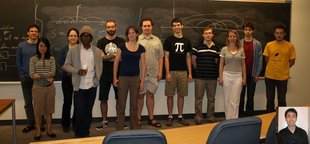
Class Photo
090924-2: [math]\displaystyle{ {\mathcal A} }[/math] is a co-commutative algebra, the relation with products of invariants, [math]\displaystyle{ {\mathcal A} }[/math] is a bi-algebra.
|
| 4
|
Sep 28
|
Homework Assignment 1
Homework Assignment 1 Solutions
090929: The Milnor-Moore theorem, primitives, the map [math]\displaystyle{ {\mathcal A}^r\to{\mathcal A} }[/math].
091001-1: Jacobi diagrams, AS, IHX, STU, and the equivalence of all that with 4T.
091001-2: The very basics on Lie algebras.
|
| 5
|
Oct 5
|
091006: Lie algebraic weight systems, [math]\displaystyle{ gl_N }[/math].
091008-1: More on [math]\displaystyle{ gl_N }[/math], Lie algebras and the four colour theorem.
091008-2: The "abstract tenssor" approach to weight systems, [math]\displaystyle{ {\mathcal U}({\mathfrak g}) }[/math] and PBW, the map [math]\displaystyle{ {\mathcal T}_{\mathfrak g} }[/math].
|
| 6
|
Oct 12
|
091013: Algebraic properties of [math]\displaystyle{ {\mathcal U}({\mathfrak g}) }[/math] vs. algebraic properties of [math]\displaystyle{ {\mathcal A} }[/math].
Thursday's class canceled.
|
| 7
|
Oct 19
|
091020: Universal finite type invariants, filtered and graded spaces, expansions.
Homework Assignment 2
The Stonehenge Story
091022-1: The Stonehenge Story to IHX and STU.
091022-2: The Stonhenge Story: anomalies, framings, relation with physics.
|
| 8
|
Oct 26
|
091027: Knotted trivalent graphs and their chord diagrams.
091029-1: Zsuzsi Dancso on the Kontsevich Integral (1).
091029-2: Zsuzsi Dancso on the Kontsevich Integral (2).
|
| 9
|
Nov 2
|
091103: The details of [math]\displaystyle{ {\mathcal A}^{TG} }[/math].
091105-1: Three basic problems: genus, unknotting numbers, ribbon knots.
091105-2: The three basic problems and algebraic knot theory.
|
| 10
|
Nov 9
|
091110: Tangles and planar algebras, shielding and the generators of KTG.
Homework Assignment 3
No Thursday class.
|
| 11
|
Nov 16
|
Local Khovanov Homology
091119-1: Local Khovanov homology, I.
091119-2: Local Khovanov homology, II.
|
| 12
|
Nov 23
|
091124: Emulation of one structure inside another, deriving the pentagon.
091126-1: Peter Lee on braided monoidal categories, I.
091126-2: Peter Lee on braided monoidal categories, II.
|
| 13
|
Nov 30
|
091201: The relations in KTG.
091203-1: The Existence of the Exponential Function.
091203-2: The Final Exam, Dror's failures.
|
| F
|
Dec 7
|
The Final Exam on Thu Dec 10, 9-11, Bahen 6183.
|
| Register of Good Deeds / To Do List
|
Add your name / see who's in!
|
|
|
Solve the following problems and submit them in class by October 29, 2009:
Problem 1. Let [math]\displaystyle{ {\mathfrak g}_1 }[/math] and [math]\displaystyle{ {\mathfrak g}_2 }[/math] be finite dimensional metrized Lie algebras, let [math]\displaystyle{ {\mathfrak g}_1\oplus{\mathfrak g}_2 }[/math] denote their direct sum with the obvious "orthogonal" bracket and metric, and let [math]\displaystyle{ m }[/math] be the canonical isomorphism [math]\displaystyle{ m:{\mathcal U}({\mathfrak g}_1)\otimes{\mathcal U}({\mathfrak g}_2)\to{\mathcal U}({\mathfrak g}_1\oplus{\mathfrak g}_2) }[/math]. Prove that
[math]\displaystyle{ {\mathcal T}_{{\mathfrak g}_1\oplus{\mathfrak g}_2} = m\circ({\mathcal T}_{{\mathfrak g}_1}\otimes{\mathcal T}_{{\mathfrak g}_2})\circ\Box }[/math],
where [math]\displaystyle{ \Box:{\mathcal A}(\uparrow)\to{\mathcal A}(\uparrow)\otimes{\mathcal A}(\uparrow) }[/math] is the co-product and [math]\displaystyle{ {\mathcal T}_{{\mathfrak g}} }[/math] denotes the [math]\displaystyle{ {\mathcal U}({\mathfrak g}) }[/math]-valued "tensor map" on [math]\displaystyle{ {\mathcal A} }[/math]. Can you relate this with the first problem of HW1?
Problem 2.
- Find a concise algorithm to compute the weight system [math]\displaystyle{ W_{so} }[/math] associated with the Lie algebra [math]\displaystyle{ so(N) }[/math] in its defining representation.
- Verify that your algorithm indeed satisfies the [math]\displaystyle{ 4T }[/math] relation.
Problem 3. The Kauffman polynomial [math]\displaystyle{ F(K)(a,z) }[/math] (see [Kauffman]) of a knot or link [math]\displaystyle{ K }[/math] is [math]\displaystyle{ a^{-w(K)}L(K) }[/math] where [math]\displaystyle{ w(L) }[/math] is the writhe of [math]\displaystyle{ K }[/math] and where [math]\displaystyle{ L(K) }[/math] is the regular isotopy invariant defined by the skein relations
[math]\displaystyle{ L(s_\pm)=a^{\pm 1}L(s)) }[/math]
(here [math]\displaystyle{ s }[/math] is a strand and [math]\displaystyle{ s_\pm }[/math] is the same strand with a [math]\displaystyle{ \pm }[/math] kink added) and
[math]\displaystyle{ L(\backoverslash)+L(\slashoverback) = z\left(L(\smoothing)+L(\hsmoothing)\right) }[/math]
and by the initial condition [math]\displaystyle{ L(\bigcirc)=1 }[/math]. State and prove the relationship between [math]\displaystyle{ F }[/math] and [math]\displaystyle{ W_{so} }[/math].
Mandatory but unenforced. Find yourself in the class photo and identify yourself as explained in the photo page.
[Kauffman] ^ L. H. Kauffman, An invariant of regular isotopy, Trans. Amer. Math. Soc. 312 (1990) 417-471.


