11-1100-Pgadey-Lect5
Simplicity of [math]\displaystyle{ A_n }[/math].
- Claim
- [math]\displaystyle{ A_n }[/math] is simple for [math]\displaystyle{ n \neq 4 }[/math].
For [math]\displaystyle{ n = 1 }[/math] we have that [math]\displaystyle{ A_n = \{e\} }[/math] which is simple. For [math]\displaystyle{ n=2 }[/math] we have that [math]\displaystyle{ S_n = \{(12), e\} }[/math], and once again [math]\displaystyle{ A_n = \{e\} }[/math]. For [math]\displaystyle{ n = 3 }[/math] we have that [math]\displaystyle{ A_n = \{e, (123), (132)\} \simeq Z/3Z }[/math] which is of prime order, and hence has no proper subgroups (by Lagrange). It follows that it has no normal proper subgroups.
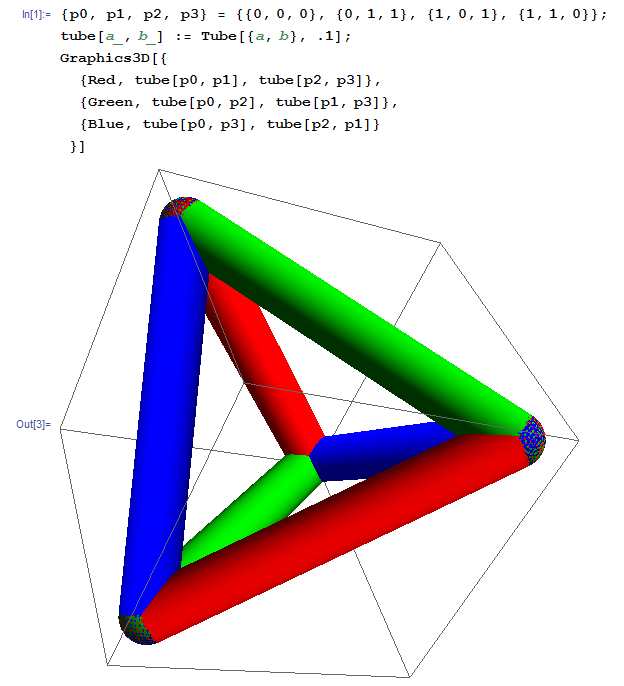
For [math]\displaystyle{ n = 4 }[/math] we have Dror's Favourite Homomorphism (the map [math]\displaystyle{ S_4 \rightarrow S_3 }[/math] given by a coloured tetrahedron (link)
[This proof is not a deep conceptual proof. It is the product of a lot of playing around with cycles, and generators. This is much like a solution to the Rubik's cube, it naturally arises from a lot of playing around -- but is not conceptually deep at all.]
We proceed with some unmotivated computations: [math]\displaystyle{ (12)(23) = (123) \quad \quad (12)(34) = (123)(234) }[/math] These are the main ingredients of the proof. The first equality says that a product of transpositions of non-disjoint pairs is a 3-cycle, the second equality says that the product of a pair of disjoint transpositions is a product of three cycles. Thus any product of two transpositions can be written a product of three cycles. [ The second equality is amusing with physical objects. ]
- Lemma 1
- [math]\displaystyle{ A_n }[/math] is generated by three cycles in [math]\displaystyle{ S_n }[/math]. That is, [math]\displaystyle{ A_n = \langle \{ (ijk) \in S_n \} \rangle }[/math].
We have that each element of [math]\displaystyle{ A_n }[/math] is the product of an even number of transpositions (braid diagrams, computation with polynomials, etc). But we can replace a pair of 2-cycles with one or two 3-cycles by the computation above. It follows that any element of the alternating group can be rewritten as a product of 3-cycles.
- Lemma 2
- If [math]\displaystyle{ N \triangleleft A_n }[/math] contains a 3-cycle then [math]\displaystyle{ N=A_n }[/math].
Up to changing notation, we have that [math]\displaystyle{ (123) \in N }[/math]. We show that [math]\displaystyle{ (123)^\sigma \in N }[/math] for any [math]\displaystyle{ \sigma \in S_n }[/math]. By normality, we have this for [math]\displaystyle{ \sigma \in A_n }[/math]. If [math]\displaystyle{ \sigma \not\in A_n }[/math] we can write [math]\displaystyle{ \sigma = (12)\sigma' }[/math] for [math]\displaystyle{ \sigma \in A_n }[/math]. But then [math]\displaystyle{ (123)^{(12)} = (123)^2 }[/math] and thus [math]\displaystyle{ (123)^\sigma = \left( (123)^{(12)} \right)^{\sigma'} \in N }[/math] Since all 3-cycles are conjugate to [math]\displaystyle{ (123) }[/math] we have that all 3-cycles are in [math]\displaystyle{ N }[/math]. It follows by Lemma 1 that [math]\displaystyle{ N = A_n }[/math].
- Case I
- [math]\displaystyle{ N }[/math] contains a cycle of length [math]\displaystyle{ \geq 4 }[/math].
[math]\displaystyle{ \sigma= (123456)\sigma' \in N \Rightarrow \sigma^{-1} (123) \sigma (123)^{-1} = (136) \in N }[/math]
The claim then follows by Lemma 2.
- Case II
- If [math]\displaystyle{ N }[/math] contains an with two cycles of length 3.
[math]\displaystyle{ \sigma = (123)(456) \sigma' \in N \Rightarrow \sigma^{-1}(124)\sigma(124)^{-1} = (14263) \in N }[/math]
The claim then follows by Case I.
- Case III
- If [math]\displaystyle{ N }[/math] contains [math]\displaystyle{ \sigma = (123)(\textrm{a product of disjoint 2-cycles}) }[/math]
We have that [math]\displaystyle{ \sigma^2 = (132) \in N }[/math]. The claim then follows by Lemma 1.
- Case IV
- If every element of [math]\displaystyle{ N }[/math] is a product of disjoint 2-cycles.
We have that [math]\displaystyle{ \sigma = (12)(34)\sigma' \Rightarrow \sigma^{-1}(123)\sigma(123)^{-1} = (13)(24) = \tau \in N }[/math] But then [math]\displaystyle{ \tau^{-1}(125)\tau(125)^{-1} = (13452) \in N }[/math]. The claim then follows by Case 1.
[Note: This last case is the only place where we really use this mystical fifth element. Without it, this last step wouldn't go through.]
Throwback to [math]\displaystyle{ S_4 }[/math]
- Claim
- [math]\displaystyle{ S_4 }[/math] contains no normal [math]\displaystyle{ H }[/math] such that [math]\displaystyle{ H \simeq S_3 }[/math].
[math]\displaystyle{ S_3 }[/math] has an element of order three, therefore [math]\displaystyle{ H }[/math] does. We then conjugate to get all the three cycles. Then [math]\displaystyle{ H }[/math] is too big.
[ Suppose that [math]\displaystyle{ (123) \in H }[/math], then
[math]\displaystyle{ S = \{ e, (123), (132), (124), (142), (134), (143), (234), (243)\} \subset H }[/math]
Which implies that [math]\displaystyle{ |S_3| = 6 \lt 9 \leq |H| }[/math], but since [math]\displaystyle{ H \simeq S_3 }[/math] we have [math]\displaystyle{ |H| = |S_3| }[/math], a contradiction.]
Group Actions
- A group [math]\displaystyle{ G }[/math] acting on a set [math]\displaystyle{ X }[/math]
A left (resp. right) group action of [math]\displaystyle{ G }[/math] on [math]\displaystyle{ X }[/math] is a binary map [math]\displaystyle{ G \times X \rightarrow X }[/math] denotes by [math]\displaystyle{ (g,x) \mapsto gx }[/math] satisfying:
- [math]\displaystyle{ ex = x }[/math] (resp. [math]\displaystyle{ xe = x }[/math])
- [math]\displaystyle{ (g_1g_2)x = g_1(g_2x) }[/math] (resp [math]\displaystyle{ (xg_1)g_2 }[/math])
- [The above implies [math]\displaystyle{ ex = x }[/math] and [math]\displaystyle{ gy = x \Rightarrow g^{-1}y=x }[/math].]
Examples of group actions
- [math]\displaystyle{ G }[/math] acting on itself by conjugation (a right action). [math]\displaystyle{ (g,g') \mapsto g^{g'} }[/math]
- Let [math]\displaystyle{ S(X) }[/math] be the set of bijections from [math]\displaystyle{ X }[/math] to [math]\displaystyle{ X }[/math], with group structure given by composition. We then have an [math]\displaystyle{ S(X) }[/math]-action of [math]\displaystyle{ X }[/math] given [math]\displaystyle{ x \mapsto gx : X \rightarrow X \in S(X) }[/math]
@@color:green ; //[Where does the shirt come into the business?! ]// @@
- If [math]\displaystyle{ G = (\mathcal{G}, \cdot) }[/math] is a group where [math]\displaystyle{ \mathcal{S} }[/math] is the underlying set of [math]\displaystyle{ G }[/math] and [math]\displaystyle{ \cdot }[/math] is the group multiplication. We have an action: [math]\displaystyle{ (g,s) = g \cdot s }[/math] this gives a map [math]\displaystyle{ G \rightarrow S(\mathcal{G}) }[/math].
- [math]\displaystyle{ SO(n) }[/math] is the group of orientation preserving symmetries of the [math]\displaystyle{ (n-1) }[/math]-dimensional sphere. We have that [math]\displaystyle{ SO(2) \leq SO(3) }[/math] as the subgroup of rotations that fix the north and south pole. There is a map [math]\displaystyle{ SO(3)/SO(2) \rightarrow S^2 }[/math] given by looking at the image of the north pole.
- If [math]\displaystyle{ H \leq G }[/math] which may not be normal, then we have an action of [math]\displaystyle{ G }[/math] on [math]\displaystyle{ G/H }[/math] given by [math]\displaystyle{ g(xH) = (gx)H }[/math].
- We have [math]\displaystyle{ S_{n-1} \leq S_n }[/math] and [math]\displaystyle{ |S_n / S_{n-1}| = n!/(n-1)! = n }[/math].
- Exercise
- Show that [math]\displaystyle{ S_n }[/math] acting on [math]\displaystyle{ \{1, 2, \dots, n\} }[/math] and [math]\displaystyle{ S_n / S_{n-1} }[/math] are isomorphic [math]\displaystyle{ S_n }[/math]-sets.
[Dror violently resists rigorously defining a category. Gives a little speech about "things" and "arrows". Gives an example of taking a topological space [math]\displaystyle{ T }[/math] and then looking at the space of paths with identities given by staying still, and composition of paths given by concatenation.]
- Claim
- Left [math]\displaystyle{ G }[/math]-sets form a category.
The objects of the category are actions [math]\displaystyle{ G \times X \rightarrow X }[/math]. The morphisms, if we have [math]\displaystyle{ X }[/math] and [math]\displaystyle{ Y }[/math] are [math]\displaystyle{ G }[/math]-sets, a morphism of [math]\displaystyle{ G }[/math]-sets is a function [math]\displaystyle{ \gamma : X \rightarrow Y }[/math] such that [math]\displaystyle{ \gamma(gx) = g(\gamma(x)) }[/math].
- Isomorphism of [math]\displaystyle{ G }[/math]-sets
- An isomorphism of [math]\displaystyle{ G }[/math]-sets is a morphism which is bijective.
- Silly fact
- If [math]\displaystyle{ X_1 }[/math] and [math]\displaystyle{ X_2 }[/math] are [math]\displaystyle{ G }[/math]-sets then so is [math]\displaystyle{ X_1 \coprod X_2 }[/math], the disjoint union of the two.
the next statement combines the silly observation above, with the construction of an action of [math]\displaystyle{ G }[/math] on [math]\displaystyle{ G/H }[/math].
- Claim
- Any [math]\displaystyle{ G }[/math]-set [math]\displaystyle{ X }[/math] is a disjoint unions of the "transitive [math]\displaystyle{ G }[/math]-sets". And If [math]\displaystyle{ Y }[/math] is a transitive [math]\displaystyle{ G }[/math]-set, then [math]\displaystyle{ Y \simeq G/H }[/math] for some [math]\displaystyle{ H \leq G }[/math].