09-240/Classnotes for Tuesday September 15: Difference between revisions
From Drorbn
Jump to navigationJump to search
(Make gallery for Yangjiay.) |
(→Examples: note for "iff") |
||
| Line 38: | Line 38: | ||
# <math>\,\!F_7 = \{ 0, 1,2,3,4,5,6 \}</math> |
# <math>\,\!F_7 = \{ 0, 1,2,3,4,5,6 \}</math> |
||
# <math>\,\!F_6 = \{ 0, 1,2,3,4,5 \}</math> is not a field (counterexample) |
# <math>\,\!F_6 = \{ 0, 1,2,3,4,5 \}</math> is not a field (counterexample) |
||
'''Theorem''': <math>\,\!F_P </math> for <math>p>1</math> is a field '' |
'''Theorem''': <math>\,\!F_P </math> for <math>p>1</math> is a field ''iff'' <small>([http://en.wikipedia.org/wiki/If_and_only_if if and only if])</small> <math>p</math> is a prime number |
||
== Tedious Theorem == |
== Tedious Theorem == |
||
Revision as of 22:28, 15 September 2009
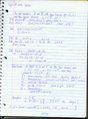
Page 1
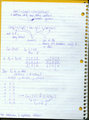
Page 2
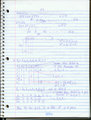
Page 3
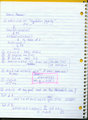
Page 4
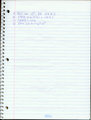
Page 5


The real numbers A set [math]\displaystyle{ \mathbb R }[/math] with two binary operators and two special elements [math]\displaystyle{ 0, 1 \in \mathbb R }[/math] s.t.
- [math]\displaystyle{ F1.\quad \forall a, b \in \mathbb R, a + b = b + a \mbox{ and } a \cdot b = b \cdot a }[/math]
- [math]\displaystyle{ F2.\quad \forall a, b, c, (a + b) + c = a + (b + c) \mbox{ and } (a \cdot b) \cdot c = a \cdot (b \cdot c) }[/math]
- [math]\displaystyle{ \mbox{(So for any real numbers } a_1, a_2, ..., a_n, \mbox{ one can sum them in any order and achieve the same result.} }[/math]
- [math]\displaystyle{ F3.\quad \forall a, a + 0 = a \mbox{ and } a \cdot 0 = 0 \mbox{ and } a \cdot 1 = a }[/math]
- [math]\displaystyle{ F4.\quad \forall a, \exists b, a + b = 0 \mbox{ and } \forall a \ne 0, \exists b, a \cdot b = 1 }[/math]
- [math]\displaystyle{ \mbox{So } a + (-a) = 0 \mbox{ and } a \cdot a^{-1} = 1 }[/math]
- [math]\displaystyle{ \mbox{(So } (a + b) \cdot (a - b) = a^2 - b^2) }[/math]
- [math]\displaystyle{ \forall a, \exists x, x \cdot x = a \mbox{ or } a + x \cdot x = 0 }[/math]
- Note: or means inclusive or in math.
- [math]\displaystyle{ F5.\quad (a + b) \cdot c = a \cdot c + b \cdot c }[/math]
Definition: A field is a set F with two binary operators [math]\displaystyle{ \,\!+ }[/math]: F×F → F, [math]\displaystyle{ \times\,\! }[/math]: F×F → F and two elements [math]\displaystyle{ 0, 1 \in \mathbb R }[/math] s.t.
- [math]\displaystyle{ F1\quad \mbox{Commutativity } a + b = b + a \mbox{ and } a \cdot b = b \cdot a \forall a, b \in F }[/math]
- [math]\displaystyle{ F2\quad \mbox{Associativity } (a + b) + c = a + (b + c) \mbox{ and } (a \cdot b) \cdot c = a \cdot (b \cdot c) }[/math]
- [math]\displaystyle{ F3\quad a + 0 = a, a \cdot 1 = a }[/math]
- [math]\displaystyle{ F4\quad \forall a, \exists b, a + b = 0 \mbox{ and } \forall a \ne 0, \exists b, a \cdot b = 1 }[/math]
- [math]\displaystyle{ F5\quad \mbox{Distributivity } (a + b) \cdot c = a \cdot c + b \cdot c }[/math]
Examples
- [math]\displaystyle{ F = \mathbb R }[/math]
- [math]\displaystyle{ F = \mathbb Q }[/math]
- [math]\displaystyle{ \mathbb C = \{ a + bi : a, b \in \mathbb R \} }[/math]
- [math]\displaystyle{ i = \sqrt{-1} }[/math]
- [math]\displaystyle{ \,\!(a + bi) + (c + di) = (a + c) + (b + d)i }[/math]
- [math]\displaystyle{ \,\!0 = 0 + 0i, 1 = 1 + 0i }[/math]
- [math]\displaystyle{ \,\!F_2 = \{ 0, 1 \} }[/math]
- [math]\displaystyle{ \,\!F_7 = \{ 0, 1,2,3,4,5,6 \} }[/math]
- [math]\displaystyle{ \,\!F_6 = \{ 0, 1,2,3,4,5 \} }[/math] is not a field (counterexample)
Theorem: [math]\displaystyle{ \,\!F_P }[/math] for [math]\displaystyle{ p\gt 1 }[/math] is a field iff (if and only if) [math]\displaystyle{ p }[/math] is a prime number
Tedious Theorem
- [math]\displaystyle{ a + b = c + d \Rightarrow a = c }[/math] "cancellation property"
- [math]\displaystyle{ a \cdot b = c \cdot b , (b \ne 0) \Rightarrow a = c }[/math]
...
