11-1100-Pgadey-Lect5: Difference between revisions

From Drorbn
Jump to navigationJump to search
No edit summary
 
No edit summary
 
(9 intermediate revisions by the same user not shown)
Line 1: Line 1:
!! Simplicity of $A_n$.
== Simplicity of <math>A_n</math>. ==


;Claim
;Claim
: $A_n$ is simple for $n \neq 4$.
: <math>A_n</math> is simple for <math>n \neq 4</math>.
For $n = 1$ we have that $A_n = \{e\}$ which is simple.
For <math>n = 1 </math> we have that <math>A_n = \{e\} </math> which is simple.
For $n=2$ we have that $S_n = \{(12), e\}$, and once again $A_n = \{e\}$.
For <math>n=2 </math> we have that <math>S_n = \{(12), e\} </math>, and once again <math>A_n = \{e\} </math>.
For $n = 3$ we have that $A_n = \{e, (123), (132)\} \simeq Z/3Z$ which is of prime order, and hence has no proper subgroups (by Lagrange). It follows that it has no normal proper subgroups.
For <math>n = 3 </math> we have that <math>A_n = \{e, (123), (132)\} \simeq Z/3Z </math> which is of prime order, and hence has no proper subgroups (by Lagrange). It follows that it has no normal proper subgroups.


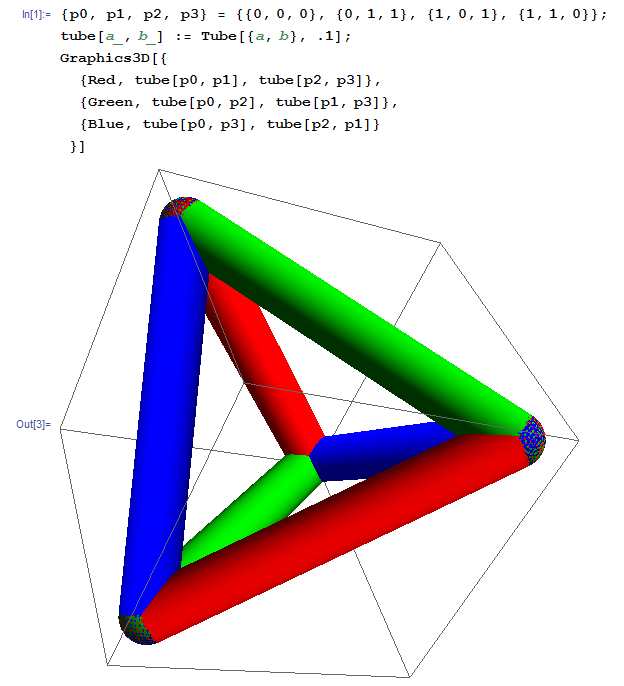
For $n = 4$ we have @@color: red ; Dror's Favourite Homomorphism @@
For <math>n = 4 </math> we have <span style="color:red">Dror's Favourite Homomorphism (the map <math>S_4 \rightarrow S_3</math> given by a coloured tetrahedron [http://katlas.math.toronto.edu/drorbn/AcademicPensieve/Classes/11-1100/ColouredTetrahedron.png (link)] </span>


<span style="color:green">[This proof is not a deep conceptual proof. It is the product of a lot of playing around with cycles, and generators. This is much like a solution to the Rubik's cube, it naturally arises from a lot of playing around -- but is not conceptually deep at all.]</span>
We proceed with some unmotivated computations,
@@color: green ; //[ This proof is not a deep conceptual proof. It is the product of a lot of playing around with cycles, and generators. This is much like a solution to the Rubik's cube, it naturally arises from a lot of playing around -- but is not conceptually deep at all.]// @@

Some computations:
$$ (12)(23) = (123) \quad \quad (12)(34) = (123)(234) $$
These are the main ingredients of the proof


We proceed with some unmotivated computations:
<math>(12)(23) = (123) \quad \quad (12)(34) = (123)(234)</math>
These are the main ingredients of the proof. The first equality says that a product of transpositions of non-disjoint pairs is a 3-cycle, the second equality says that the product of a pair of disjoint transpositions is a product of three cycles. Thus any product of two transpositions can be written a product of three cycles. <span style="color:green">[ The second equality is amusing with physical objects. ]</span>
; Lemma 1
; Lemma 1
: $A_n$ is generated by three cycles in $S_n$. That is, $A_n = \langle \{ (ijk) \in S_n \} \rangle$.
: <math>A_n</math> is generated by three cycles in <math>S_n</math>. That is, <math>A_n = \langle \{ (ijk) \in S_n \} \rangle</math>.


We have that each element of $A_n$ is the product of an even number of transpositions@@color:green ; (braid diagrams, computation with polynomials, etc)@@. But we can replace a pair of 2-cycles with one or two 3-cycles by the computation above. It follows that any element of the alternating group can be rewritten as a product of 3-cycles.
We have that each element of <math>A_n </math> is the product of an even number of transpositions <span style="color:green">(braid diagrams, computation with polynomials, etc)</span>. But we can replace a pair of 2-cycles with one or two 3-cycles by the computation above. It follows that any element of the alternating group can be rewritten as a product of 3-cycles.


; Lemma 2
; Lemma 2
: If $N \triangleleft A_n$ contains a 3-cycle then $N=A_n$.
: If <math>N \triangleleft A_n</math> contains a 3-cycle then <math>N=A_n</math>.
Up to changing notation, we have that $(123) \in N$. We show that $(123)^\sigma \in N$ for any $\sigma \in S_n$. By normality, we have this for $\sigma \in A_n$. If $\sigma \not\in A_n$ we can write $\sigma = (12)\sigma'$ for $\sigma \in A_n$. But then $(123)^{(12)} = (123)^2$ and thus
Up to changing notation, we have that <math>(123) \in N</math>. We show that <math>(123)^\sigma \in N</math> for any <math>\sigma \in S_n</math>. By normality, we have this for <math>\sigma \in A_n</math>. If <math>\sigma \not\in A_n</math> we can write <math>\sigma = (12)\sigma'</math> for <math>\sigma \in A_n</math>. But then <math>(123)^{(12)} = (123)^2</math> and thus
$$(123)^\sigma = \left( (123)^{(12)} \right)^{\sigma'} \in N $$
<math> (123)^\sigma = \left( (123)^{(12)} \right)^{\sigma'} \in N</math>
Since all 3-cycles are conjugate to $(123)$ we have that all 3-cycles are in $N$. It follows by Lemma 1 that $N = A_n$.
Since all 3-cycles are conjugate to <math>(123)</math> we have that all 3-cycles are in <math>N</math>. It follows by Lemma 1 that <math>N = A_n</math>.


;//Case I//
;''Case I''
: $N$ contains a cycle of length $\geq 4$.
: <math>N</math> contains a cycle of length <math>\geq 4</math>.
$$ \sigma= (123456)\sigma' \in N \Rightarrow \sigma^{-1} (123) \sigma (123)^{-1} = (136) \in N $$
<math> \sigma= (123456)\sigma' \in N \Rightarrow \sigma^{-1} (123) \sigma (123)^{-1} = (136) \in N </math>
The claim then follows by Lemma 2.


;//Case II//
;''Case II''
: If $N$ contains an with two cycles of length 3.
: If <math>N </math> contains an with two cycles of length 3.
$$ \sigma = (123)(456) \sigma' \in N \Rightarrow \sigma^{-1}(124)\sigma(124)^{-1} = (14263) \in N$$
<math> \sigma = (123)(456) \sigma' \in N \Rightarrow \sigma^{-1}(124)\sigma(124)^{-1} = (14263) \in N </math>
The claim then follows by //Case I//.
The claim then follows by ''Case I''.


;//Case III//
;''Case III''
: If $N$ contains $\sigma = (123)(\textrm{a product of disjoint 2-cycles})$
: If <math>N </math> contains <math>\sigma = (123)(\textrm{a product of disjoint 2-cycles}) </math>
We have that $\sigma^2 = (132) \in N$. The claim then follows by Lemma 1.
We have that <math>\sigma^2 = (132) \in N </math>. The claim then follows by Lemma 1.


;//Case IV//
;''Case IV''
: If every element of $N$ is a product of disjoint 2-cycles.
: If every element of <math>N </math> is a product of disjoint 2-cycles.
We have that
We have that
$$\sigma = (12)(34)\sigma' \Rightarrow \sigma^{-1}(123)\sigma(123)^{-1} = (13)(24) = \tau \in N$$
<math> \sigma = (12)(34)\sigma' \Rightarrow \sigma^{-1}(123)\sigma(123)^{-1} = (13)(24) = \tau \in N </math>
But then $\tau^{-1}(125)\tau(125)^{-1} = (13452) \in N$.
But then <math>\tau^{-1}(125)\tau(125)^{-1} = (13452) \in N </math>.
The claim then follows by Case 1.


@@color:green ; //[Note: This last case is the _only_ place where we really use this mystical fifth element. Without it, this last step wouldn't go through. ]// @@
<span style="color:green">[Note: This last case is the '''only''' place where we really use this mystical fifth element. Without it, this last step wouldn't go through.]</span>


== Throwback to <math>S_4</math> ==
!! Throwback: $S_4$ contains no normal $H$ such that $H \simeq S_3$.
;Claim
:<math>S_4 </math> contains no normal <math>H </math> such that <math>H \simeq S_3 </math>.


$S_3$ has an element of order three, therefore $H$ does. We then conjugate to get all the three cycles. Then $H$ is too big.
<math>S_3 </math> has an element of order three, therefore <math>H </math> does. We then conjugate to get all the three cycles. Then <math>H </math> is too big.


//[ Suppose that $(123) \in H$, then
[ Suppose that <math>(123) \in H </math>, then


$$ S = \{ e, (123), (132), (124), (142), (134), (143), (234), (243)\} \subset H $$
<math> S = \{ e, (123), (132), (124), (142), (134), (143), (234), (243)\} \subset H </math>
Which implies that $|S_3| = 6 < 9 \leq |H|$, but since $H \simeq S_3$ we have $|H| = |S_3|$, a contradiction.]//
Which implies that <math>|S_3| = 6 < 9 \leq |H| </math>, but since <math>H \simeq S_3 </math> we have <math>|H| = |S_3| </math>, a contradiction.]


!!Group Actions.
== Group Actions ==


; A group $G$ acting on a set $X$
; A group <math>G </math> acting on a set <math>X </math>
A left (resp. right) group action of $G$ on $X$ is a binary map $G \times X \rightarrow X$ denotes by $(g,x) \mapsto gx$ satisfying:
A left (resp. right) group action of <math>G </math> on <math>X </math> is a binary map <math>G \times X \rightarrow X </math> denotes by <math>(g,x) \mapsto gx </math> satisfying:
* $ex = x$ (resp. $xe = x$)
* <math>ex = x </math> (resp. <math>xe = x </math>)
* $(g_1g_2)x = g_1(g_2x)$ (resp $(xg_1)g_2$)
* <math>(g_1g_2)x = g_1(g_2x) </math> (resp <math>(xg_1)g_2 </math>)
* [The above implies $ex = x$ and $gy = x \Rightarrow g^{-1}y=x$.]
* [The above implies <math>ex = x </math> and <math>gy = x \Rightarrow g^{-1}y=x </math>.]


!! Examples of group actions
=== Examples of group actions ===
* $G$ acting on itself by conjugation (a right action). $(g,g') \mapsto g^{g'}$
* <math>G </math> acting on itself by conjugation (a right action). <math>(g,g') \mapsto g^{g'} </math>
* Let $S(X)$ be the set of bijections from $X$ to $X$, with group structure given by composition. We then have an $S(X)$-action of $X$ given $x \mapsto gx : X \rightarrow X \in S(X)$
* Let <math>S(X) </math> be the set of bijections from <math>X </math> to <math>X </math>, with group structure given by composition. We then have an <math>S(X) </math>-action of <math>X </math> given <math>x \mapsto gx : X \rightarrow X \in S(X) </math>
@@color:green ; //[Where does the shirt come into the business?! ]// @@
<span style="color:green">["Where does the shirt come into the business?!" Dror's remark after talking about the symmetry of a student's shirt.]</span>
* If $G = (\mathcal{G}, \cdot)$ is a group where $\mathcal{S}$ is the underlying set of $G$ and $\cdot$ is the group multiplication. We have an action: $(g,s) = g \cdot s$ this gives a map $G \rightarrow S(\mathcal{G})$.
* If <math>G = (\mathcal{G}, \cdot) </math> is a group where <math>\mathcal{S} </math> is the underlying set of <math>G </math> and <math>\cdot </math> is the group multiplication. We have an action: <math>(g,s) = g \cdot s </math> this gives a map <math>G \rightarrow S(\mathcal{G}) </math>.
* $SO(n)$ is the group of orientation preserving symmetries of the $(n-1)$-dimensional sphere. We have that $SO(2) \leq SO(3)$ as the subgroup of rotations that fix the north and south pole. There is a map $SO(3)/SO(2) \rightarrow S^2$ given by looking at the image of the north pole.
* <math>SO(n) </math> is the group of orientation preserving symmetries of the <math>(n-1) </math>-dimensional sphere. We have that <math>SO(2) \leq SO(3) </math> as the subgroup of rotations that fix the north and south pole. There is a map <math>SO(3)/SO(2) \rightarrow S^2 </math> given by looking at the image of the north pole.
* If $H \leq G$ which may not be normal, then we have an action of $G$ on $G/H$ given by $g(xH) = (gx)H$.
* If <math>H \leq G </math> which may not be normal, then we have an action of <math>G </math> on <math>G/H </math> given by <math>g(xH) = (gx)H </math>.
* We have $S_{n-1} \leq S_n$ and $|S_n / S_{n-1}| = n!/(n-1)! = n$.
* We have <math>S_{n-1} \leq S_n </math> and <math>|S_n / S_{n-1}| = n!/(n-1)! = n </math>.
; Exercise
; Exercise
: Show that $S_n$ acting on $\{1, 2, \dots, n\}$ and $S_n / S_{n-1}$ are isomorphic $S_n$-sets.
: Show that <math>S_n </math> acting on <math>\{1, 2, \dots, n\} </math> and <math>S_n / S_{n-1} </math> are isomorphic <math>S_n </math>-sets.


@@color:green ; //[Dror violently resists rigorously defining a category. Gives a little speech about "things" and "arrows". Gives an example of taking a topological space $T$ and then looking at the space of paths with identities given by staying still, and composition of paths given by concatenation.]//@@
<span style="color:green">[Dror violently resists rigorously defining a category. Gives a little speech about "things" and "arrows". Gives an example of taking a topological space <math>T </math> and then looking at the space of paths with identities given by staying still, and composition of paths given by concatenation.]</span>


; Claim
; Claim
: Left $G$-sets form a category.
: Left <math>G </math>-sets form a category.


The objects of the category are actions <math>G \times X \rightarrow X </math>. The morphisms, if we have <math>X </math> and <math>Y </math> are <math>G </math>-sets, a morphism of <math>G </math>-sets is a function <math>\gamma : X \rightarrow Y </math> such that <math>\gamma(gx) = g(\gamma(x)) </math>.
@@color:green ; //[Dror: I'm being a little bit biased. I prefer the left over the right. Parker: Propaganda? ]//@@


; Isomorphism of <math>G </math>-sets
The objects of the category are actions $G \times X \rightarrow X$. The morphisms, if we have $X$ and $Y$ are $G$-sets, a morphism of $G$-sets is a function $\gamma : X \rightarrow Y$ such that $\gamma(gx) = g(\gamma(x))$.
: An isomorphism of <math>G </math>-sets is a morphism which is bijective.

; Isomorphism of $G$-sets
: An isomorphism of $G$-sets is a morphism which is bijective.


; Silly fact
; Silly fact
: If $X_1$ and $X_2$ are $G$-sets then so is $X_1 \coprod X_2$, the disjoint union of the two.
: If <math>X_1 </math> and <math>X_2 </math> are <math>G </math>-sets then so is <math>X_1 \coprod X_2 </math>, the disjoint union of the two.


the next statement combines the silly observation above, with the construction of an action of $G$ on $G/H$.
the next statement combines the silly observation above, with the construction of an action of <math>G </math> on <math>G/H </math>.

;
Claim
;Claim
: Any $G$-set $X$ is a disjoint unions of the ``transitive $G$-sets''. And If $Y$ is a transitive $G$-set, then $Y \simeq G/H$ for some $H \leq G$.
: Any <math>G </math>-set <math>X </math> is a disjoint unions of the "transitive <math>G </math>-sets". And If <math>Y </math> is a transitive <math>G </math>-set, then <math>Y \simeq G/H </math> for some <math>H \leq G </math>.

Latest revision as of 20:14, 4 October 2011

Simplicity of Failed to parse (SVG (MathML can be enabled via browser plugin): Invalid response ("Math extension cannot connect to Restbase.") from server "https://wikimedia.org/api/rest_v1/":): {\displaystyle A_n} .

Claim
Failed to parse (SVG (MathML can be enabled via browser plugin): Invalid response ("Math extension cannot connect to Restbase.") from server "https://wikimedia.org/api/rest_v1/":): {\displaystyle A_n} is simple for .

For Failed to parse (SVG (MathML can be enabled via browser plugin): Invalid response ("Math extension cannot connect to Restbase.") from server "https://wikimedia.org/api/rest_v1/":): {\displaystyle n = 1 } we have that Failed to parse (SVG (MathML can be enabled via browser plugin): Invalid response ("Math extension cannot connect to Restbase.") from server "https://wikimedia.org/api/rest_v1/":): {\displaystyle A_n = \{e\} } which is simple. For Failed to parse (SVG (MathML can be enabled via browser plugin): Invalid response ("Math extension cannot connect to Restbase.") from server "https://wikimedia.org/api/rest_v1/":): {\displaystyle n=2 } we have that Failed to parse (SVG (MathML can be enabled via browser plugin): Invalid response ("Math extension cannot connect to Restbase.") from server "https://wikimedia.org/api/rest_v1/":): {\displaystyle S_n = \{(12), e\} } , and once again Failed to parse (SVG (MathML can be enabled via browser plugin): Invalid response ("Math extension cannot connect to Restbase.") from server "https://wikimedia.org/api/rest_v1/":): {\displaystyle A_n = \{e\} } . For Failed to parse (SVG (MathML can be enabled via browser plugin): Invalid response ("Math extension cannot connect to Restbase.") from server "https://wikimedia.org/api/rest_v1/":): {\displaystyle n = 3 } we have that Failed to parse (SVG (MathML can be enabled via browser plugin): Invalid response ("Math extension cannot connect to Restbase.") from server "https://wikimedia.org/api/rest_v1/":): {\displaystyle A_n = \{e, (123), (132)\} \simeq Z/3Z } which is of prime order, and hence has no proper subgroups (by Lagrange). It follows that it has no normal proper subgroups.

For Failed to parse (SVG (MathML can be enabled via browser plugin): Invalid response ("Math extension cannot connect to Restbase.") from server "https://wikimedia.org/api/rest_v1/":): {\displaystyle n = 4 } we have Dror's Favourite Homomorphism (the map given by a coloured tetrahedron (link)

[This proof is not a deep conceptual proof. It is the product of a lot of playing around with cycles, and generators. This is much like a solution to the Rubik's cube, it naturally arises from a lot of playing around -- but is not conceptually deep at all.]

We proceed with some unmotivated computations: Failed to parse (SVG (MathML can be enabled via browser plugin): Invalid response ("Math extension cannot connect to Restbase.") from server "https://wikimedia.org/api/rest_v1/":): {\displaystyle (12)(23) = (123) \quad \quad (12)(34) = (123)(234)} These are the main ingredients of the proof. The first equality says that a product of transpositions of non-disjoint pairs is a 3-cycle, the second equality says that the product of a pair of disjoint transpositions is a product of three cycles. Thus any product of two transpositions can be written a product of three cycles. [ The second equality is amusing with physical objects. ]

Lemma 1
Failed to parse (SVG (MathML can be enabled via browser plugin): Invalid response ("Math extension cannot connect to Restbase.") from server "https://wikimedia.org/api/rest_v1/":): {\displaystyle A_n} is generated by three cycles in Failed to parse (SVG (MathML can be enabled via browser plugin): Invalid response ("Math extension cannot connect to Restbase.") from server "https://wikimedia.org/api/rest_v1/":): {\displaystyle S_n} . That is, Failed to parse (SVG (MathML can be enabled via browser plugin): Invalid response ("Math extension cannot connect to Restbase.") from server "https://wikimedia.org/api/rest_v1/":): {\displaystyle A_n = \langle \{ (ijk) \in S_n \} \rangle} .

We have that each element of Failed to parse (SVG (MathML can be enabled via browser plugin): Invalid response ("Math extension cannot connect to Restbase.") from server "https://wikimedia.org/api/rest_v1/":): {\displaystyle A_n } is the product of an even number of transpositions (braid diagrams, computation with polynomials, etc). But we can replace a pair of 2-cycles with one or two 3-cycles by the computation above. It follows that any element of the alternating group can be rewritten as a product of 3-cycles.

Lemma 2
If Failed to parse (SVG (MathML can be enabled via browser plugin): Invalid response ("Math extension cannot connect to Restbase.") from server "https://wikimedia.org/api/rest_v1/":): {\displaystyle N \triangleleft A_n} contains a 3-cycle then .

Up to changing notation, we have that Failed to parse (SVG (MathML can be enabled via browser plugin): Invalid response ("Math extension cannot connect to Restbase.") from server "https://wikimedia.org/api/rest_v1/":): {\displaystyle (123) \in N} . We show that Failed to parse (SVG (MathML can be enabled via browser plugin): Invalid response ("Math extension cannot connect to Restbase.") from server "https://wikimedia.org/api/rest_v1/":): {\displaystyle (123)^\sigma \in N} for any Failed to parse (SVG (MathML can be enabled via browser plugin): Invalid response ("Math extension cannot connect to Restbase.") from server "https://wikimedia.org/api/rest_v1/":): {\displaystyle \sigma \in S_n} . By normality, we have this for Failed to parse (SVG (MathML can be enabled via browser plugin): Invalid response ("Math extension cannot connect to Restbase.") from server "https://wikimedia.org/api/rest_v1/":): {\displaystyle \sigma \in A_n} . If Failed to parse (SVG (MathML can be enabled via browser plugin): Invalid response ("Math extension cannot connect to Restbase.") from server "https://wikimedia.org/api/rest_v1/":): {\displaystyle \sigma \not\in A_n} we can write Failed to parse (SVG (MathML can be enabled via browser plugin): Invalid response ("Math extension cannot connect to Restbase.") from server "https://wikimedia.org/api/rest_v1/":): {\displaystyle \sigma = (12)\sigma'} for Failed to parse (SVG (MathML can be enabled via browser plugin): Invalid response ("Math extension cannot connect to Restbase.") from server "https://wikimedia.org/api/rest_v1/":): {\displaystyle \sigma \in A_n} . But then and thus Failed to parse (SVG (MathML can be enabled via browser plugin): Invalid response ("Math extension cannot connect to Restbase.") from server "https://wikimedia.org/api/rest_v1/":): {\displaystyle (123)^\sigma = \left( (123)^{(12)} \right)^{\sigma'} \in N} Since all 3-cycles are conjugate to Failed to parse (SVG (MathML can be enabled via browser plugin): Invalid response ("Math extension cannot connect to Restbase.") from server "https://wikimedia.org/api/rest_v1/":): {\displaystyle (123)} we have that all 3-cycles are in Failed to parse (SVG (MathML can be enabled via browser plugin): Invalid response ("Math extension cannot connect to Restbase.") from server "https://wikimedia.org/api/rest_v1/":): {\displaystyle N} . It follows by Lemma 1 that Failed to parse (SVG (MathML can be enabled via browser plugin): Invalid response ("Math extension cannot connect to Restbase.") from server "https://wikimedia.org/api/rest_v1/":): {\displaystyle N = A_n} .

Case I
Failed to parse (SVG (MathML can be enabled via browser plugin): Invalid response ("Math extension cannot connect to Restbase.") from server "https://wikimedia.org/api/rest_v1/":): {\displaystyle N} contains a cycle of length Failed to parse (SVG (MathML can be enabled via browser plugin): Invalid response ("Math extension cannot connect to Restbase.") from server "https://wikimedia.org/api/rest_v1/":): {\displaystyle \geq 4} .
Failed to parse (SVG (MathML can be enabled via browser plugin): Invalid response ("Math extension cannot connect to Restbase.") from server "https://wikimedia.org/api/rest_v1/":): {\displaystyle  \sigma= (123456)\sigma' \in N \Rightarrow \sigma^{-1} (123) \sigma (123)^{-1} = (136) \in N }

The claim then follows by Lemma 2.

Case II
If Failed to parse (SVG (MathML can be enabled via browser plugin): Invalid response ("Math extension cannot connect to Restbase.") from server "https://wikimedia.org/api/rest_v1/":): {\displaystyle N } contains an with two cycles of length 3.

The claim then follows by Case I.

Case III
If Failed to parse (SVG (MathML can be enabled via browser plugin): Invalid response ("Math extension cannot connect to Restbase.") from server "https://wikimedia.org/api/rest_v1/":): {\displaystyle N } contains Failed to parse (SVG (MathML can be enabled via browser plugin): Invalid response ("Math extension cannot connect to Restbase.") from server "https://wikimedia.org/api/rest_v1/":): {\displaystyle \sigma = (123)(\textrm{a product of disjoint 2-cycles}) }

We have that Failed to parse (SVG (MathML can be enabled via browser plugin): Invalid response ("Math extension cannot connect to Restbase.") from server "https://wikimedia.org/api/rest_v1/":): {\displaystyle \sigma^2 = (132) \in N } . The claim then follows by Lemma 1.

Case IV
If every element of Failed to parse (SVG (MathML can be enabled via browser plugin): Invalid response ("Math extension cannot connect to Restbase.") from server "https://wikimedia.org/api/rest_v1/":): {\displaystyle N } is a product of disjoint 2-cycles.

We have that Failed to parse (SVG (MathML can be enabled via browser plugin): Invalid response ("Math extension cannot connect to Restbase.") from server "https://wikimedia.org/api/rest_v1/":): {\displaystyle \sigma = (12)(34)\sigma' \Rightarrow \sigma^{-1}(123)\sigma(123)^{-1} = (13)(24) = \tau \in N } But then Failed to parse (SVG (MathML can be enabled via browser plugin): Invalid response ("Math extension cannot connect to Restbase.") from server "https://wikimedia.org/api/rest_v1/":): {\displaystyle \tau^{-1}(125)\tau(125)^{-1} = (13452) \in N } . The claim then follows by Case 1.

[Note: This last case is the only place where we really use this mystical fifth element. Without it, this last step wouldn't go through.]

Throwback to Failed to parse (SVG (MathML can be enabled via browser plugin): Invalid response ("Math extension cannot connect to Restbase.") from server "https://wikimedia.org/api/rest_v1/":): {\displaystyle S_4}

Claim
Failed to parse (SVG (MathML can be enabled via browser plugin): Invalid response ("Math extension cannot connect to Restbase.") from server "https://wikimedia.org/api/rest_v1/":): {\displaystyle S_4 } contains no normal Failed to parse (SVG (MathML can be enabled via browser plugin): Invalid response ("Math extension cannot connect to Restbase.") from server "https://wikimedia.org/api/rest_v1/":): {\displaystyle H } such that .
Failed to parse (SVG (MathML can be enabled via browser plugin): Invalid response ("Math extension cannot connect to Restbase.") from server "https://wikimedia.org/api/rest_v1/":): {\displaystyle S_3 }
 has an element of order three, therefore Failed to parse (SVG (MathML can be enabled via browser plugin): Invalid response ("Math extension cannot connect to Restbase.") from server "https://wikimedia.org/api/rest_v1/":): {\displaystyle H }
 does. We then conjugate to get all the three cycles. Then Failed to parse (SVG (MathML can be enabled via browser plugin): Invalid response ("Math extension cannot connect to Restbase.") from server "https://wikimedia.org/api/rest_v1/":): {\displaystyle H }
 is too big.

[ Suppose that Failed to parse (SVG (MathML can be enabled via browser plugin): Invalid response ("Math extension cannot connect to Restbase.") from server "https://wikimedia.org/api/rest_v1/":): {\displaystyle (123) \in H } , then

Failed to parse (SVG (MathML can be enabled via browser plugin): Invalid response ("Math extension cannot connect to Restbase.") from server "https://wikimedia.org/api/rest_v1/":): {\displaystyle  S = \{ e, (123), (132), (124), (142), (134), (143), (234), (243)\} \subset H }

Which implies that Failed to parse (SVG (MathML can be enabled via browser plugin): Invalid response ("Math extension cannot connect to Restbase.") from server "https://wikimedia.org/api/rest_v1/":): {\displaystyle |S_3| = 6 < 9 \leq |H| } , but since Failed to parse (SVG (MathML can be enabled via browser plugin): Invalid response ("Math extension cannot connect to Restbase.") from server "https://wikimedia.org/api/rest_v1/":): {\displaystyle H \simeq S_3 } we have Failed to parse (SVG (MathML can be enabled via browser plugin): Invalid response ("Math extension cannot connect to Restbase.") from server "https://wikimedia.org/api/rest_v1/":): {\displaystyle |H| = |S_3| } , a contradiction.]

Group Actions

A group Failed to parse (SVG (MathML can be enabled via browser plugin): Invalid response ("Math extension cannot connect to Restbase.") from server "https://wikimedia.org/api/rest_v1/":): {\displaystyle G } acting on a set Failed to parse (SVG (MathML can be enabled via browser plugin): Invalid response ("Math extension cannot connect to Restbase.") from server "https://wikimedia.org/api/rest_v1/":): {\displaystyle X }

A left (resp. right) group action of Failed to parse (SVG (MathML can be enabled via browser plugin): Invalid response ("Math extension cannot connect to Restbase.") from server "https://wikimedia.org/api/rest_v1/":): {\displaystyle G } on Failed to parse (SVG (MathML can be enabled via browser plugin): Invalid response ("Math extension cannot connect to Restbase.") from server "https://wikimedia.org/api/rest_v1/":): {\displaystyle X } is a binary map Failed to parse (SVG (MathML can be enabled via browser plugin): Invalid response ("Math extension cannot connect to Restbase.") from server "https://wikimedia.org/api/rest_v1/":): {\displaystyle G \times X \rightarrow X } denotes by Failed to parse (SVG (MathML can be enabled via browser plugin): Invalid response ("Math extension cannot connect to Restbase.") from server "https://wikimedia.org/api/rest_v1/":): {\displaystyle (g,x) \mapsto gx } satisfying:

  • (resp. Failed to parse (SVG (MathML can be enabled via browser plugin): Invalid response ("Math extension cannot connect to Restbase.") from server "https://wikimedia.org/api/rest_v1/":): {\displaystyle xe = x } )
  • Failed to parse (SVG (MathML can be enabled via browser plugin): Invalid response ("Math extension cannot connect to Restbase.") from server "https://wikimedia.org/api/rest_v1/":): {\displaystyle (g_1g_2)x = g_1(g_2x) } (resp Failed to parse (SVG (MathML can be enabled via browser plugin): Invalid response ("Math extension cannot connect to Restbase.") from server "https://wikimedia.org/api/rest_v1/":): {\displaystyle (xg_1)g_2 } )
  • [The above implies Failed to parse (SVG (MathML can be enabled via browser plugin): Invalid response ("Math extension cannot connect to Restbase.") from server "https://wikimedia.org/api/rest_v1/":): {\displaystyle ex = x } and Failed to parse (SVG (MathML can be enabled via browser plugin): Invalid response ("Math extension cannot connect to Restbase.") from server "https://wikimedia.org/api/rest_v1/":): {\displaystyle gy = x \Rightarrow g^{-1}y=x } .]

Examples of group actions

  • Failed to parse (SVG (MathML can be enabled via browser plugin): Invalid response ("Math extension cannot connect to Restbase.") from server "https://wikimedia.org/api/rest_v1/":): {\displaystyle G } acting on itself by conjugation (a right action). Failed to parse (SVG (MathML can be enabled via browser plugin): Invalid response ("Math extension cannot connect to Restbase.") from server "https://wikimedia.org/api/rest_v1/":): {\displaystyle (g,g') \mapsto g^{g'} }
  • Let Failed to parse (SVG (MathML can be enabled via browser plugin): Invalid response ("Math extension cannot connect to Restbase.") from server "https://wikimedia.org/api/rest_v1/":): {\displaystyle S(X) } be the set of bijections from Failed to parse (SVG (MathML can be enabled via browser plugin): Invalid response ("Math extension cannot connect to Restbase.") from server "https://wikimedia.org/api/rest_v1/":): {\displaystyle X } to Failed to parse (SVG (MathML can be enabled via browser plugin): Invalid response ("Math extension cannot connect to Restbase.") from server "https://wikimedia.org/api/rest_v1/":): {\displaystyle X } , with group structure given by composition. We then have an Failed to parse (SVG (MathML can be enabled via browser plugin): Invalid response ("Math extension cannot connect to Restbase.") from server "https://wikimedia.org/api/rest_v1/":): {\displaystyle S(X) } -action of Failed to parse (SVG (MathML can be enabled via browser plugin): Invalid response ("Math extension cannot connect to Restbase.") from server "https://wikimedia.org/api/rest_v1/":): {\displaystyle X } given Failed to parse (SVG (MathML can be enabled via browser plugin): Invalid response ("Math extension cannot connect to Restbase.") from server "https://wikimedia.org/api/rest_v1/":): {\displaystyle x \mapsto gx : X \rightarrow X \in S(X) }

["Where does the shirt come into the business?!" Dror's remark after talking about the symmetry of a student's shirt.]

  • If Failed to parse (SVG (MathML can be enabled via browser plugin): Invalid response ("Math extension cannot connect to Restbase.") from server "https://wikimedia.org/api/rest_v1/":): {\displaystyle G = (\mathcal{G}, \cdot) } is a group where Failed to parse (SVG (MathML can be enabled via browser plugin): Invalid response ("Math extension cannot connect to Restbase.") from server "https://wikimedia.org/api/rest_v1/":): {\displaystyle \mathcal{S} } is the underlying set of Failed to parse (SVG (MathML can be enabled via browser plugin): Invalid response ("Math extension cannot connect to Restbase.") from server "https://wikimedia.org/api/rest_v1/":): {\displaystyle G } and Failed to parse (SVG (MathML can be enabled via browser plugin): Invalid response ("Math extension cannot connect to Restbase.") from server "https://wikimedia.org/api/rest_v1/":): {\displaystyle \cdot } is the group multiplication. We have an action: Failed to parse (SVG (MathML can be enabled via browser plugin): Invalid response ("Math extension cannot connect to Restbase.") from server "https://wikimedia.org/api/rest_v1/":): {\displaystyle (g,s) = g \cdot s } this gives a map Failed to parse (SVG (MathML can be enabled via browser plugin): Invalid response ("Math extension cannot connect to Restbase.") from server "https://wikimedia.org/api/rest_v1/":): {\displaystyle G \rightarrow S(\mathcal{G}) } .
  • Failed to parse (SVG (MathML can be enabled via browser plugin): Invalid response ("Math extension cannot connect to Restbase.") from server "https://wikimedia.org/api/rest_v1/":): {\displaystyle SO(n) } is the group of orientation preserving symmetries of the Failed to parse (SVG (MathML can be enabled via browser plugin): Invalid response ("Math extension cannot connect to Restbase.") from server "https://wikimedia.org/api/rest_v1/":): {\displaystyle (n-1) } -dimensional sphere. We have that Failed to parse (SVG (MathML can be enabled via browser plugin): Invalid response ("Math extension cannot connect to Restbase.") from server "https://wikimedia.org/api/rest_v1/":): {\displaystyle SO(2) \leq SO(3) } as the subgroup of rotations that fix the north and south pole. There is a map Failed to parse (SVG (MathML can be enabled via browser plugin): Invalid response ("Math extension cannot connect to Restbase.") from server "https://wikimedia.org/api/rest_v1/":): {\displaystyle SO(3)/SO(2) \rightarrow S^2 } given by looking at the image of the north pole.
  • If Failed to parse (SVG (MathML can be enabled via browser plugin): Invalid response ("Math extension cannot connect to Restbase.") from server "https://wikimedia.org/api/rest_v1/":): {\displaystyle H \leq G } which may not be normal, then we have an action of Failed to parse (SVG (MathML can be enabled via browser plugin): Invalid response ("Math extension cannot connect to Restbase.") from server "https://wikimedia.org/api/rest_v1/":): {\displaystyle G } on Failed to parse (SVG (MathML can be enabled via browser plugin): Invalid response ("Math extension cannot connect to Restbase.") from server "https://wikimedia.org/api/rest_v1/":): {\displaystyle G/H } given by Failed to parse (SVG (MathML can be enabled via browser plugin): Invalid response ("Math extension cannot connect to Restbase.") from server "https://wikimedia.org/api/rest_v1/":): {\displaystyle g(xH) = (gx)H } .
  • We have Failed to parse (SVG (MathML can be enabled via browser plugin): Invalid response ("Math extension cannot connect to Restbase.") from server "https://wikimedia.org/api/rest_v1/":): {\displaystyle S_{n-1} \leq S_n } and Failed to parse (SVG (MathML can be enabled via browser plugin): Invalid response ("Math extension cannot connect to Restbase.") from server "https://wikimedia.org/api/rest_v1/":): {\displaystyle |S_n / S_{n-1}| = n!/(n-1)! = n } .
Exercise
Show that Failed to parse (SVG (MathML can be enabled via browser plugin): Invalid response ("Math extension cannot connect to Restbase.") from server "https://wikimedia.org/api/rest_v1/":): {\displaystyle S_n } acting on Failed to parse (SVG (MathML can be enabled via browser plugin): Invalid response ("Math extension cannot connect to Restbase.") from server "https://wikimedia.org/api/rest_v1/":): {\displaystyle \{1, 2, \dots, n\} } and Failed to parse (SVG (MathML can be enabled via browser plugin): Invalid response ("Math extension cannot connect to Restbase.") from server "https://wikimedia.org/api/rest_v1/":): {\displaystyle S_n / S_{n-1} } are isomorphic Failed to parse (SVG (MathML can be enabled via browser plugin): Invalid response ("Math extension cannot connect to Restbase.") from server "https://wikimedia.org/api/rest_v1/":): {\displaystyle S_n } -sets.

[Dror violently resists rigorously defining a category. Gives a little speech about "things" and "arrows". Gives an example of taking a topological space Failed to parse (SVG (MathML can be enabled via browser plugin): Invalid response ("Math extension cannot connect to Restbase.") from server "https://wikimedia.org/api/rest_v1/":): {\displaystyle T } and then looking at the space of paths with identities given by staying still, and composition of paths given by concatenation.]

Claim
Left Failed to parse (SVG (MathML can be enabled via browser plugin): Invalid response ("Math extension cannot connect to Restbase.") from server "https://wikimedia.org/api/rest_v1/":): {\displaystyle G } -sets form a category.

The objects of the category are actions Failed to parse (SVG (MathML can be enabled via browser plugin): Invalid response ("Math extension cannot connect to Restbase.") from server "https://wikimedia.org/api/rest_v1/":): {\displaystyle G \times X \rightarrow X } . The morphisms, if we have Failed to parse (SVG (MathML can be enabled via browser plugin): Invalid response ("Math extension cannot connect to Restbase.") from server "https://wikimedia.org/api/rest_v1/":): {\displaystyle X } and Failed to parse (SVG (MathML can be enabled via browser plugin): Invalid response ("Math extension cannot connect to Restbase.") from server "https://wikimedia.org/api/rest_v1/":): {\displaystyle Y } are Failed to parse (SVG (MathML can be enabled via browser plugin): Invalid response ("Math extension cannot connect to Restbase.") from server "https://wikimedia.org/api/rest_v1/":): {\displaystyle G } -sets, a morphism of Failed to parse (SVG (MathML can be enabled via browser plugin): Invalid response ("Math extension cannot connect to Restbase.") from server "https://wikimedia.org/api/rest_v1/":): {\displaystyle G } -sets is a function Failed to parse (SVG (MathML can be enabled via browser plugin): Invalid response ("Math extension cannot connect to Restbase.") from server "https://wikimedia.org/api/rest_v1/":): {\displaystyle \gamma : X \rightarrow Y } such that Failed to parse (SVG (MathML can be enabled via browser plugin): Invalid response ("Math extension cannot connect to Restbase.") from server "https://wikimedia.org/api/rest_v1/":): {\displaystyle \gamma(gx) = g(\gamma(x)) } .

Isomorphism of Failed to parse (SVG (MathML can be enabled via browser plugin): Invalid response ("Math extension cannot connect to Restbase.") from server "https://wikimedia.org/api/rest_v1/":): {\displaystyle G } -sets
An isomorphism of Failed to parse (SVG (MathML can be enabled via browser plugin): Invalid response ("Math extension cannot connect to Restbase.") from server "https://wikimedia.org/api/rest_v1/":): {\displaystyle G } -sets is a morphism which is bijective.
Silly fact
If Failed to parse (SVG (MathML can be enabled via browser plugin): Invalid response ("Math extension cannot connect to Restbase.") from server "https://wikimedia.org/api/rest_v1/":): {\displaystyle X_1 } and Failed to parse (SVG (MathML can be enabled via browser plugin): Invalid response ("Math extension cannot connect to Restbase.") from server "https://wikimedia.org/api/rest_v1/":): {\displaystyle X_2 } are Failed to parse (SVG (MathML can be enabled via browser plugin): Invalid response ("Math extension cannot connect to Restbase.") from server "https://wikimedia.org/api/rest_v1/":): {\displaystyle G } -sets then so is Failed to parse (SVG (MathML can be enabled via browser plugin): Invalid response ("Math extension cannot connect to Restbase.") from server "https://wikimedia.org/api/rest_v1/":): {\displaystyle X_1 \coprod X_2 } , the disjoint union of the two.

the next statement combines the silly observation above, with the construction of an action of Failed to parse (SVG (MathML can be enabled via browser plugin): Invalid response ("Math extension cannot connect to Restbase.") from server "https://wikimedia.org/api/rest_v1/":): {\displaystyle G } on Failed to parse (SVG (MathML can be enabled via browser plugin): Invalid response ("Math extension cannot connect to Restbase.") from server "https://wikimedia.org/api/rest_v1/":): {\displaystyle G/H } .

Claim
Any Failed to parse (SVG (MathML can be enabled via browser plugin): Invalid response ("Math extension cannot connect to Restbase.") from server "https://wikimedia.org/api/rest_v1/":): {\displaystyle G } -set Failed to parse (SVG (MathML can be enabled via browser plugin): Invalid response ("Math extension cannot connect to Restbase.") from server "https://wikimedia.org/api/rest_v1/":): {\displaystyle X } is a disjoint unions of the "transitive Failed to parse (SVG (MathML can be enabled via browser plugin): Invalid response ("Math extension cannot connect to Restbase.") from server "https://wikimedia.org/api/rest_v1/":): {\displaystyle G } -sets". And If Failed to parse (SVG (MathML can be enabled via browser plugin): Invalid response ("Math extension cannot connect to Restbase.") from server "https://wikimedia.org/api/rest_v1/":): {\displaystyle Y } is a transitive Failed to parse (SVG (MathML can be enabled via browser plugin): Invalid response ("Math extension cannot connect to Restbase.") from server "https://wikimedia.org/api/rest_v1/":): {\displaystyle G } -set, then for some Failed to parse (SVG (MathML can be enabled via browser plugin): Invalid response ("Math extension cannot connect to Restbase.") from server "https://wikimedia.org/api/rest_v1/":): {\displaystyle H \leq G } .