User:Wongpak: Difference between revisions
From Drorbn
Jump to navigationJump to search
(→Span) |
No edit summary |
||
| Line 1: | Line 1: | ||
===Linear Combination=== |
|||
Definition: Let (''u''<sub>i</sub>) = (''u''<sub>1</sub>, ''u''<sub>2</sub>, ..., ''u''<sub>n</sub>) be a sequence of vectors in V. A sum of the form<br> |
|||
::''a''<sub>i</sub> <math> \in </math> F, <math>\sum_{i=1}^n</math> ''a''<sub>i</sub>''u''<sub>i</sub> = ''a''<sub>1</sub>''u''<sub>1</sub> + ''a''<sub>2</sub>''u''<sub>2</sub>+ ... +''a''<sub>n</sub>''u''<sub>n</sub> |
|||
is called a "Linear Combination" of the ''u''<sub>i</sub>. |
|||
===Span=== |
===Span=== |
||
Revision as of 14:06, 29 September 2006
Span
span(ui):= The set of all possible linear combinations of the ui's.
If V is any subset,

| span | := The set of all linear combination of vectors in |
| = |

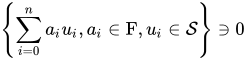
even if is empty.
Theorem: For any V, span is a subspace of V.
Proof:
1. 0 span .
2. Let x span , Let x span ,
x = aiui, ui , y = bivi, vi .
x+y = aiui + bivi = ciwi where ci=(a1, a2,...,an, b1, b2,...,bm) and wi=ci=(u1, u2,...,un, v1, v2,...,vm).
3. cx= c aiui= (cai)ui span .


